PET-Lignin Polyols

Patent Title: HIGH RECYCLE CONTENT POLYOLS FROM THERMOPLASTIC POLYESTERS AND LIGNIN OR TANNIN

 Number/Link: WO2016/118411

Applicant/Assignee: Resinate Materials Group

Publication date: 28-07-2016

Gist”: PET is glycolized and then reacted with lignin or tannin

Why it is interesting: This application is about ‘sustainable’ aromatic polyester polyols partly based on recycled materials and partly on biorenewable materials. According to the invention the polyols can be prepared by first glycolizing (waste) PET and subsequently reacting the mixture with lignin at 110-210°C while removing volatile condensation products.  The resulting polyols (pref) show a OH value between 40 and 400 mg KOH/g, a fn of 2-2.2 and a viscosity at 25°C of 500 to 3000 cP. In the examples polyols with up to 25 wt% lignin are shown. The polyols are said to be useful e.g. in 2K PU coating compositions.
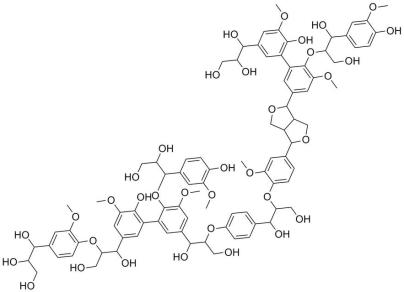
Part of a lignin structure
Part of a lignin structure

Self-Crosslinkable Polyurethane

Patent Title: Self-Crosslinkable Polymer and Aqueous Dispersion Comprising Particles of the Same

 Number/Link: US2016/0159959

Applicant/Assignee: Valspar Sourcing

Publication date: 9-06-2016

Gist”: Aqueous dispersion of polyurethane having both azide and carbonyl groups in the backbone

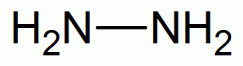
Why it is interesting: Properties of water-based PU coatings can often be improved by incorporating olefinically unsaturated groups in the polymer which can be crosslinked using radiation. According to this invention a self-crosslinking (i.e. without the need for radiation) aqueous PU coating composition can be made by incorporating both azide- and carbonyl groups into the PU backbone. When the water evaporates and the film forms these groups will react forming a hydrazone-type bond. The self-crosslinkabe polymer can be prepared by first making an NCO-ended prepolymer containing a reactive double bond, by (e.g.) reacting some of the NCO groups with hydroxyethylmethacrylate (HEMA). This prepolymer is then dispersed in water together with hydrazine and and acrylate like MMA or BA. The hydrazine will react with the NCO groups, introducing azide groups into the backbone.  The acrylate and the prepolymer are then suspension polymerized using an initiator.  The PU backbone can (optionally) contain a water dispersible group – e.g. by incorporating dimethylolpropanoic acid. The self-crosslinkable polymer is said to be especially useful for use in wood coating compositions.

Hydrazine

Hydrazine


Polyurethane-Acrylate Plastisol

Patent Title: ACRYLIC-URETHANE IPN PLASTISOL

 Number/Link: US2016/0152857

Applicant/Assignee: Polyone

Publication date: 2-06-2016

Gist”: Plastisols from blocked-iso grafted acrylate in plasticizer

Why it is interesting:
Conventional plastisols are suspensions of PVC particles in a (usuallly phthalate-) plasticizer. The suspension can be cured by heating, which results in a plasticized elastomer.  Plastisols are used for coatings of e.g. car underbodies and for ‘screen printing’ of textiles. According to this invention a non-PVC plastisol can be produced by dispersing core-shell acrylate polymer particles (Mn between 300,000 and 1,000,000) with blocked isocyanate groups grafted to the backbone into a plasticizer, preferably into dioctylphthalate, together with a latent amine crosslinker like adipic dihydrazide. No information is given about the blocking agent but the plastisol is said to cure at 130-170°C and be especially suited for textile printing.

Adipic dihydrazide

Adipic dihydrazide

  • Pages

  • Categories

  • Enter your email address to follow this blog and receive notifications of new posts by email.

    Join 259 other subscribers
  • Follow Innovation in PU on Twitter