Low Viscosity Systems for Fibre-Reinforced PU Composites

Title: 2K POLYURETHANE SYSTEMS WITH PHASE SEPARATION – AND-  2K POLYURETHANE SYSTEMS WITH A HIGH GLASS-TRANSITION TEMPERATURE

 Number/Link: WO2013/127732 and WO2013/127734

Applicant/Assignee: Henkel

Publication date: 6-09-2013

Gist”: Low-viscosity, high-potlife 2-component systems useful for the production of composites are prepared from a polyol and isocyanate component characterised only in that polyol and iso are immiscible (case 1) or that the di-iso contains an amount of uretonimine (case 2).

Why it is interesting: These are two rather strange cases.  The claims are very wide and the only ‘inventive step’ for the WO-32 case is that iso and polyol are chosen such that they are incompatible and phase separate after mixing as evidenced by the mixture becoming turbid.  The inventive step in the WO-34 case is that the isocyanate is based on 2,4′ and 4,4′ MDI of which 3-25% (of the NCO) has been converted to uretonimine. Advantages mentioned are low viscosity, long potlife (open time) and a high Tg after crosslinking.  In the examples a polyol/iso mixture is shown with an NCO index of 120, resp 150 without any catalyst or another additives. The ‘surprising effect’ in this invention is not immediatly clear to me and judging from the number of “X”-es in the search report the claims will most likely not get granted as such.

Carbon Fibre Composite
Carbon Fibre Composite

Polyurethane Particles for Oil Absorption

Title: METHOD FOR PRODUCING POLYURETHANE PARTICLES

 Number/Link: US2013/0224376

Applicant/Assignee: Konishi Co.

Publication date: 29-08-2013

Gist”: A PU latex is prepared from an emulsion of an NCO-prepolymer in water which is crosslinked with a  triamine in the presence of hydrophilic silica particles. The latex is then spray dried to form oil absorbing particles.

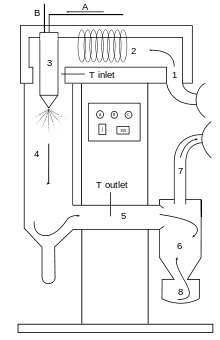
Why it is interesting: An NCO-ended IPDI-PTMEG prepolymer is dispersed in water an then crosslinked with a triamine.  To the resulting latex, hydrophilic silica particles are added and the composition is then sprayed into a high temperature atmosphere to evaporate the water and form the particles. The size of the silica particles is about 20 nm and a factor 30 smaller then the PU particles. The silica supposedly covers the PU particles so that they do not cohere and show good flow properties. The particles can be used to absorb natural  fats and oils (triglycerids)   Useful (I assume) in the pharmaceutical, cosmetic and agricultural industries (controlled release, perfumes, repellents..)

lab spraydryer schematic (Wikipedia)

lab spraydryer schematic (Wikipedia)

Brominated Polyurethane Oligomers

Title: FLAME-RETARDING OLIGOMERIC BROMINATED URETHANE COMPOSITIONS

 Number/Link: US2013/0217286

Applicant/Assignee: Lubrizol

Publication date: 22-08-2013 (priority PCT)

Gist”: Use of highly brominated isocyanate-reactive monomers to prepare brominated PU oligmers useful as non-leaching fire retardants.

Why it is interesting: Brominated fire retardants are highly effective in polyurethanes but their use is being phased-out because of environmental issues and the production of some of them will be discontinued in the near future. Brominated PU oligomers can be used as fire retardants with less environmental problems as they are not fugitive and will leach less.  The oligomers can be produced using monofunctional highly brominated isocyanate-reactive monomers like tribromoneopentanol or pentabromophenol. Difunctional brominated monomers can also be using together with monofunctional isocyanates to control the molecular weight which is preferably between 800 and 20,000 (claimed).  The oligomers can be used as fire retardants in PU dispersions (claimed) and in other polyurethane compositions e.g. in TPUs.

pentabromophenol

pentabromophenol

  • Pages

  • Categories

  • Enter your email address to follow this blog and receive notifications of new posts by email.

    Join 259 other subscribers