Polyurethane Prepregs prepared with Isosorbide

Title: STORAGE-STABLE POLYURETHANE-PREPREGS AND FIBRE COMPOSITE COMPONENTS PRODUCED THEREFROM

 Number/Link: WO2013/139704

Applicant/Assignee: Bayer

Publication date: 26-09-2013

Gist”: Polyurethane matrix materials for prepregs with very good storage stability are prepared from an NCO prepolymer together with isosorbide and delayed action catalysts.

Why it is interesting: Resins for “prepregs” (pre-impregnated fibre composites) need to have a low viscosity upon impregnation, a good storage stability and a fast ‘curing’ reaction preferably at a relatively low temperature.  According to this invention all these properties can be met by using a 8-16% NCO prepolymer made from a polyester polyol and  MDI, together with a dianhydrohexitol (preferably isosorbide) as chain extender and a delayed action catalyst (e.g. a blocked amine) which is activated between 50 and 100°C. The resulting prepregs have a storage stability at room temperature of several weeks. Final Tg is said to be 130°C, which is not very high but should suffice for many applications.
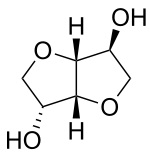
Isosorbide

Isosorbide

Enzymatic Recycling of Polyurethanes

Title: PROCESS FOR THE MATERIAL UTILIZATION OF POLYURETHANES

 Number/Link: WO2013/134801 (German)

Applicant/Assignee: Eurofoam

Publication date: 19-09-2013

Gist”: Use of specific enzymes to break down polyurethane into polyamines and its original (polyether)polyols

Why it is interesting: Chemical recycling of polyurethane by hydrolysis, glycolysis etc. is known but requires high temperatures and sometimes (when supercritical water is used) high pressures.  This can lead to side reactions and the contamination of the recycled raw materials. Enzymatic recycling of polyurethanes is known as well but is mostly limited to polyester polyurethanes and esterase enzymes which break down the ester bonds.  The current invention claims that the use of certain hydrolases of the EC3 class, especially arylacylamidase  EC3.5.1.13 selectively breaks the urethane bond. (EC=enzyme comission number). The reaction can be carried out between 30 and 50°C and at a pH of 9.5 to 11. The resulting polyols and amines can be extracted using a polar solvent. While interesting the proposed process may not be very practical as the example shows that 5 days were needed to recycle a 5 gram sample of a model foam.

Schematic representation of the enzyme catalysed reaction.

Schematic representation of the enzyme catalysed reaction.

Controlling the Tg of Viscoelastic Flexible Foams

Title: ADDITIVE FOR ADJUSTING THE GLASS TRANSITION TEMPERATURE OF VISCO-ELASTIC POLYURETHANE SOFT FOAMS

 Number/Link: WO2013/131710

Applicant/Assignee: Evonik

Publication date: 12-09-2013 (German)

Gist”: Use of the di-salt of malic acid to fine-tune the Tg of visco flex foams.

Why it is interesting: The comfort properties of viscoelastic (“memory”) foams are to a large extend controlled by the glass transition temperature of the softblock, which in turn is controlled by NCO index, softblock molecular weight, crosslink density etc. Changing these parameters can be complex however because other properties -like airflow- are affected as well. This invention teaches the surprising effect of the di-sodium-salt of malic acid (hydroxybutanedioic acid) on the Tg of these foams. Apparently a small amount of the compound has a large effect on the Tg and can therefore be used to adjust the Tg without affecting other properties to a large extend.  E.g. about 0.1 php of the salt drops the Tg with 5.5°C, by comparison 0.1 php butanol lowers the Tg only by 0.3°C.

Malic Acid

Malic Acid

  • Pages

  • Categories

  • Enter your email address to follow this blog and receive notifications of new posts by email.

    Join 259 other subscribers