Thermoplastic Polyurea Elastomers

Title: MELT PROCESSIBLE POLYUREAS AND POLYUREA-URETHANES, METHOD FOR THE PRODUCTION THEREOF AND PRODUCTS MADE THEREFROM

 Number/Link: US2013/0331538

Applicant/Assignee: University of Akron

Publication date: 12-12-2013 (priority PCT)

Gist”: Polyurea is made melt-processable by incorporating hydrogen-bond accepting chain extenders (HACE)

Why it is interesting: It is well known that polyurea elastomers with a decent hardblock content (of e.g. 30-35%) are not melt-processable. Because of very strong (bi-dentate) H-bond formation in the hard domains the material will degrade sooner than flow when heated. In this invention it is proposed to incorporate a relatively small amount of HACE to disrupt the hard domain structure and reduce flow temperature.  In an example a few parts of OH-ended pentamethylenepolycarbonate with a MW of 500 to 800 was used next to the conventional 1,6-hexamethylene chain extender to drop the flow temperature by 50°C while not affecting the tensile strength. (I suppose a NH2-ended polycarbonate could have been used as well to make an all-polyurea material).

Bi-dentate H-bonds between polurea molecules (left) disrupted by a polycarbonate group (right)

Bi-dentate H-bonds between polurea molecules (left) dusrupted by a carbonate group (right)

Toughened Thermoplastic Polyurethane

Title: Method Of Toughening Thermoplastic Polyurethane And Articles Comprising Toughened Thermoplastic Polyurethane

 Number/Link: US2013/0323512

Applicant/Assignee: Nike

Publication date: 5-12-2013

Gist”: TPU is interpenetrated with a thermosetting PU using a solvent

Why it is interesting: According to this invention a conventional TPU can be “toughened” by dipping and  swelling it in a solution containing (about) 20% of a PU-forming composition comprising a polyester polyol, a chain extender, a mixture of pure and polymeric MDI and DBTDL as a catalyst.  The solvent is preferably acetone. The swollen TPU is dried and the PU is cured by heating. It is believed that a TPU-PU interpenetrating polymer network (IPN) is formed.  The invention is targeted at improving the scuff resistance of golf balls. (scuff resistance=resistance against failure of the coating by shear stress).

Nike golf ball.

Nike golf ball.

A Simple Way to Make Nonflammable Flexible Foams

Title: METHOD FOR PRODUCING FLAME-PROTECTED POLYURETHANE FOAMS HAVING LOW BULK DENSITIES

 Number/Link: WO2013174745  (German)

Applicant/Assignee: Bayer

Publication date: 28-11-2013

Gist”: Low density flex foam is impregnated with water glass

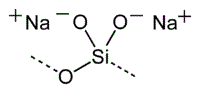
Why it is interesting: A flexible slabstock foam with a density of about 15 kg/m³ or less is submerged in a solution of amorphous water-slouble silicate, preferably a  Na-silicate, then compressed in a roller mill and dried.  The resulting foam has a (much) higher density but also a much improved flame resistance.  In an example an 11.6 kg/m³ TDI slab foam resulted in a 27.3 kg/m³ density foam after impregnation and drying.  A simple and workable idea but I doubt if it is patentable.

Sodium silicate

Sodium silicate

  • Pages

  • Categories

  • Enter your email address to follow this blog and receive notifications of new posts by email.

    Join 259 other subscribers