Self-Cleaning Coating… or not?

Title: SELF-RENEWING HYDROPHILIC ORGANIC COATINGS

 Number/Link: US2014/018466

Applicant/Assignee: Empire Technology

Publication date: 16-01-2014

Gist”: Coating containing free amine groups resulting in a hydrophilic surface that is supposedly self-cleaning.

Why it is interesting: Conventionally “self-cleaning” surfaces are produced using hydrophobic coating compositions resulting in surfaces with low contact angles with respect to water.  The current case claims that highly hydrophilic surfaces also show a self-cleaning effect.  An emulsion-polymerized polymer with blocked-isocyanate side groups is used as a coating composition.  After the coating is applied the side groups are deblocked by atmospheric moisture resulting in (hydrophilic) amine groups.  In an example 2-methyl-acrylic acid 2-isocyanatoethyl ester blocked with 3,5-dimethylpyrazole was emulsion polymerized and, together with additives, used as a coating composition.
While this is fun chemistry I very much doubt that this coating would be truly self-cleaning.  The amine groups will surely react with all kinds of stuff in the air possibly resulting in quite the opposite.
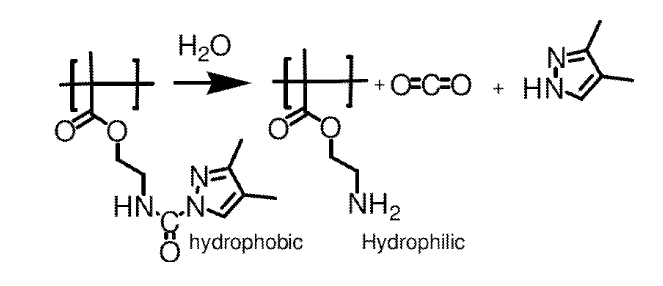
deblocking of the isocyanate side groups under the influence of water.

deblocking of the isocyanate side groups under the influence of water.

Expandable Polyurethane Particles for Insulation Panels

Title: POLYURETHANE-BASED EXPANDABLE POLYMER PARTICLES

 Number/Link: WO2014/006182  (German)

Applicant/Assignee: BASF

Publication date: 9-01-2014

Gist”: Microgranules of TPU/PS copolymer containing pentane can be expanded into insulation panels using standard EPS equipment.

Why it is interesting: Contrary to polystyrene, thermoplastic polyurethane cannot be ‘imbued’ with a physical blowing agent like pentane to make steam-expandable particles. This is due a.o. to the high diffusion rate of pentane (e.g.) in TPU.  BASF have now found that by using a TPU/PS copolymer, expandable particles can be prepared which can be used in standard EPS (expandable polystyrene) equipment to make insulation panels. The TPU used is based on 4,4′-MDI, polyTHF and butanediol such that the vicat softening point is below 80°C.   The TPU, in the form of microgranules (0.5-2mm), is swollen in styrene containing dicumylperoxide, dispersed in water and heated to polymerisation.  A blowing agent like (pref) pentane is added to the dispersion as well. The resulting particles are expandable and can be used to make insulation panels of 50-150 kg/m³.

Expandable Polystyrene.

Expandable Polystyrene.

Thermoplastic Polyurethane with a Percisely Controlled Biodegradation Rate

Title: PROCESS FOR MAKING BIODEGRADABLE AND/OR BIOABSORBABLE POLYMERS

 Number/Link: WO2014/004334

Applicant/Assignee: Lubrizol

Publication date: 03-01-2014

Gist”: Two sets of parameters are given (and claimed) which, when iteratively adjusted, allow to independently modify the mechanical properties and biodegradation rate of a TPU.

Why it is interesting: Many biomedical materials for implants such as screws, bone plates, tissue scaffolds, pins etc need high mechanical properties but also a controlled biodegradation rate which can vary from weeks to years.  According to this case the precise control of the degradation rate is not possible with currently available bio-polymers.  The invention claims two sets of parameters one which controls the physical properties of a TPU like the molecular weight, harblock content, crystallinity etc, and another set which controls the biodegradation rate like the amount of ‘hydrolyzable units’ in the backbone, hydrophilicity ect. It is claimed that both mechanical properties and degradation rate can be independently controlled by adjusting one or more parameters of each set. In the examples TPUs are prepared from HMDI, 1,4-butane diol and poly(lactide-co-caprolactone) diols where the lactide is the hydrolyzable unit.

A poly(lactide-co-caprolactone)

A poly(lactide-co-caprolactone)

  • Pages

  • Categories

  • Enter your email address to follow this blog and receive notifications of new posts by email.

    Join 259 other subscribers