Poly (Urethane-Urea) Elastomers from High 2,6-TDI

Title: Polyurethane Elastomers Based on TDI Prepolymers Enriched in the 2,6-TDI Isomer Cured with Trimethylene Glycol Di-(para Amino Benzoate)

 Number/Link: US2014/0309397

Applicant/Assignee: Anderson Development

Publication date: 16-10-2014

Gist”: Elastomers are prepared from TDI containing a high amount of the 2,6 isomer.

Why it is interesting: Commercially available toluene diisocyanate (TDI) usually comes in the 80/20 or the 65/35  2,4/2,6 isomer blend. It is known that higher 2,6 levels result in stiffer hardblocks and a different reaction profile because of the (initially) equal reactivity of the isocyanate groups. According to this invention elastomers prepared from TDI with a 2,6 content of (most preferred) at least 60% results in superior green strength and dimensional stability. High 2,6 TDI-PTMEG prepolymers cured with trimethylene glycol di(p-aminobenzoate) (TGDBA) should even have a superior tear strength and upper hardness limit compared to MDI based elastomers.

TGDBA
TGDBA

Classic PU Patent of the Month: Scott Paper Co. on Reticulated Polyurethane Foams (1964)

Title: Reticulated polyurethane foams and process for their production

 Number/Link: US3171820

Applicant/Assignee: Scott Paper Co.

Publication date: 2-03-1965

Gist”: PU foams are reticulated by hydrolysis or explosion.

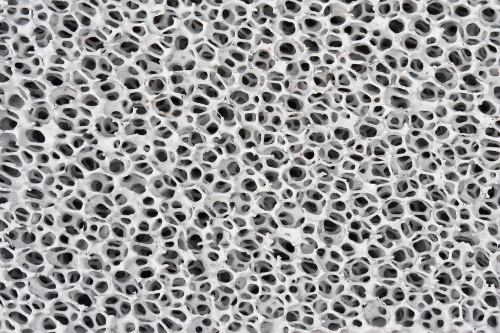
Why it is interesting:   Reticulated foams are foams from which the membranes have been removed so that only a three dimensional network of strands or ‘struts’ remains. These materials are commercially available in different grades of stiffness and porosity and are useful in applications such as filtering, sound absorbing, padding and the like. The current invention – filed in 1964 but a ‘continuation’ of an application filed in 1956- teaches the two processes to reticulate PU foam still in use today. The first process uses an aqueous NaOH solution to hydrolyse the cell membranes, in the second process a foam block is brought in an autoclave together with an explosive gas mixture (e.g. a mixture of oxigen and acetylene) which is then made to explode using a spark plug. When executed correctly the explosion removes all cell membranes leaving the struts intact. ‘Explosive recticulation’ is one of my all-time favorite PU inventions: simple, yet very effective and very courageous. In the current culture of hyper-safety where employees have to report paper-cuts, inventions like this are no longer possible.

Recticulate polyurethane foam

A recticulated polyurethane foam

Steam-Treated Polyisocyanurate

Title: PROCESS FOR MAKING URETHANE-ISOCYANURATES

 Number/Link: WO2014/160616

Applicant/Assignee: Dow

Publication date: 2-10-2014

Gist”: Treating PUR-PIR with hot water at superatmospheric pressure results in a Tg increase.

Why it is interesting: Fiber-reinforced phenol-formaldehyde composites are used to make pipes among other things.  They are however not completely stable in hot humid conditions so that they are less well suited for off-shore piping systems for example. According to this patent application, polyisocyanurate (PIR) or polyurethane-polyisocyanurate (PUR-PIR) systems are more suitable materials for such applications because properties of these materials remain stable and -surprisingly- glass transition temperature increases when subjected to high pressure water or steam. In the examples PUR-PIR systems based on polymeric MDI submerged in water at 120°C and 3500 kPa for 7 days show indeed an increase in Tg.  In my opinion it would be interesting to repeat the experiment with 4,4′-MDI based PUR/PIR.  Because 4,4′ MDI will show a higher conversion rate to PIR the ‘steam effect’ may well dissapear.

Isocyanurate group

Isocyanurate group

  • Pages

  • Categories

  • Enter your email address to follow this blog and receive notifications of new posts by email.

    Join 259 other subscribers