Polyurethane “Combination Foam”: a TPU/PU Composite

Title: KOMBINATIONSSCHAUM

 Number/Link:  WO2014/023794   (German)

Applicant/Assignee: BASF

Publication date: 13-02-2014

Gist”: Foamed TPU particles are embedded in a foamed elastomer of the same chemical composition to improve mechanical properties.

Why it is interesting: Foamed, closed-cell TPU particles are incorporated in a foamed, open-cell PU matrix which has a higher density and is produced from essentially the same chemicals, resulting in perfect compatibility and adhesion between the two components.  In the examples 30-40 % (w/w) of expanded TPU particles with a bulk density (“Shüttdichte”) of 89 kg/m³ are incorporated in an elastomer with a density of 200-300 kg/m³. Size of the TPU particles is not given but the preferred size range is 1mm to 2 cm.

Expanded TPU particles by BASF
Expanded TPU particles by BASF

Nanocomposites from PIB-Based Polyurethane and Clay

Title: POLYISOBUTYLENE-BASED POLYURETHANES CONTAINING ORGANICALLY MODIFIED MONTMORILLONITE

 Number/Link: WO/2014/018509

Applicant/Assignee: UNIVERSITY OF AKRON

Publication date: 30-01-2014

Gist”: A small amount of montmorillonite, modified with a quaternary ammonium compound containing an amine group, is incorporated in a polyisobutylene-based TPU.

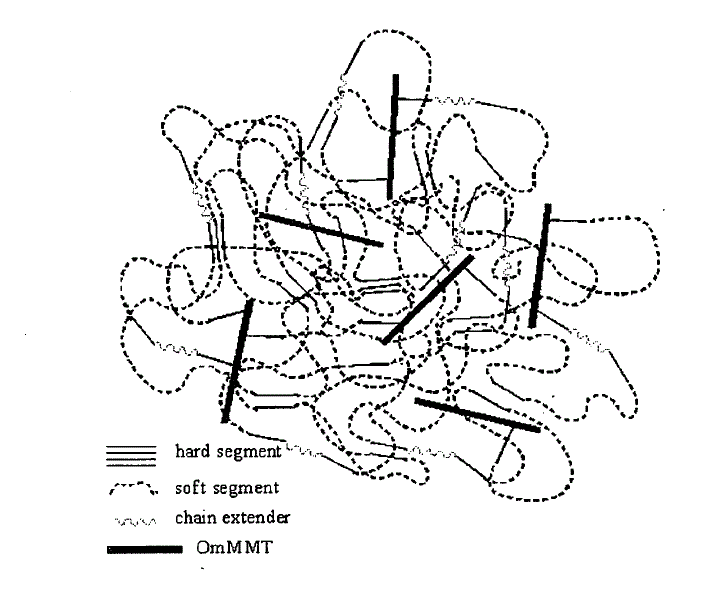
Why it is interesting: Montmorillonite-type clay is “exfoliated” using a quat. ammonium compound which has an alkyl subsituent containing a primary amine group. The salt group will electrostatically interact with the clay while the amine group will react with isocyanate when used in a polyurethane formulation, thus incorporating the clay into the polymer structure. In an example a (T)PU is made from HMDI, 1,6-hexanediol and a mixture of a 4000MW polyisobutylene diol and a 1000MW PTMO diol. A montmorillonite was exfoliated using trimethyl-1-propylamine ammonium iodide (I¯N+(CH3)3CH2CH2CH2-NH2)  and incorporated in the PU to make the nanocomposite. In an amount of 0.5% (w/w) the clay increases stiffness, mechanical- and creep properties of the PU.  However at higher amounts (2%,5%..) these properties actually deteriorate.

Polymer morphology model according to the invention.  (omMMT = organically modified montmorrilonite)

Polymer morphology model according to the invention. (omMMT = organically modified montmorillonite)

Classic PU Patent of the Month: Otto Bayer’s Invention of Polyurethane and Polyurea (1937)

Title: Verfahren zur Herstellung von Polyurethanen bzw. Polyharnstoffen

Number/Link: DE728981  (German)

Applicant/Assignee: I.G.Farbenindustrie

Publication date: 12-11-1942

Gist”: Production of polyurethanes by reacting diisocyanates and compounds containing at least two hydroxyl and/or amine groups.

Why it is interesting: This is the patent that marked the start of the polyurethane industry.   It covers both aromatic and aliphatic diisocyanates, notably NDI, MDI, TDI, HDI etc. The examples cover polyurethane and polyurea fibers and films. It is said that Bayer was trying to copy Nylon 6,6, the structure of which is very similar to a PU based on 1,6 hexanediol and 1,6 hexanediisocyanate.  The patent has only one claim:

“PATENTANSPRUCH:
Verfahren zur Herstellung von Polyurethanen bzw. Polyharnstoffen, dadurch gekennzeichnet, daβ man organische Diisocyanate mit solchen organischen Verbindungen
zur Reaktion bringt, die mindestens 2 Hydroxyl- oder Aminogruppen mit austauschbaren Wasserstoffatomen oder mindestens eine Hydroxylgruppe und mindestens eine Aminogruppe ,der genannten Art enthalten.”

Dr. Otto Bayer (1902-1982)

Dr. Otto Bayer (1902-1982)

  • Pages

  • Categories

  • Enter your email address to follow this blog and receive notifications of new posts by email.

    Join 259 other subscribers
  • Follow Innovation in PU on Twitter