One Component Polyurea

Patent Title: CYCLIC DYNAMIC POLYUREAS FOR POLYMERIC UREA PROCESSING

 Number/Link: WO2016/126756

Applicant/Assignee: University of Illinois

Publication date: 11-08-2016

Gist”: 1K polyurea coatings from thermoreversible cyclic urea oligomers

Why it is interesting: This application is related to W02016/069582 of the same applicant, discussed before on this blog. In this case the sterically hindered ureas are prepared in solvent and at a relatively low concentration. Under these conditions cyclic oligomers will be formed which can be separated and used as powder coatings, or, together with (e.g.) catalysts, polyols and crosslinkers, as liquid coatings. When heated the rings will open and the coating composition will cure. In an example 1,3-bis(isocyanatomethyl)cyclohexane  is reacted with N,N’-di-t-butyl ethylenediamine, in DMF, which forms cyclic oligomers at low-, and linear polymers at high concentrations.
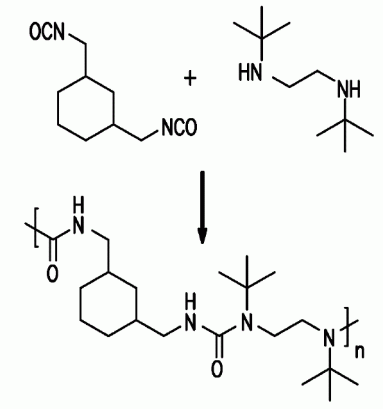
Thermoreversible polyurea according to the invention

Thermoreversible polyurea according to the invention


Highly Tuneable Shape Memory Polyurethanes

Patent Title: PROCESSABLE, TUNABLE THIOL-ENE CROSSLINKED POLYURETHANE SHAPE MEMORY POLYMERS

 Number/Link: WO2016/126703

Applicant/Assignee: Texas A&M University

Publication date: 11-08-2016

Gist”: SMPUs are made from combinations of different diisocyanates and chain extenders and different levels of crosslinking using thiol-ene click chemistry

Why it is interesting: This invention is about shape memory polyurethanes with tuneable glass transition temperature and stiffness. In a first step a low mole weight TPU is prepared from a diisocyanate and a short chain diol including some trimethylolpropane allyether (TMPAE) and allylalcohol as chain stopper. The TPU is then blended with a polythiol and a photoinitiator to allow for UV curing. The Tg can be tuned from 30 and 105°C by combining different types of chain extenders and di-iso’s ranging from DEG-HDI to CHDM-H12MDI.  The modulus (in the rubber state) can be  varied between 0.4 to 20 MPa by controlling the level of crosslinking through the amount of TMPAE and amount and type of polythiol.  The SMPUs are said to be especially useful for biomedical applications.

Reaction scheme of the invention

Reaction scheme of the invention

Polyurethane Elastomer with High Dielectric Constant

Patent Title: DIPOLE-MODIFIED POLYURETHANE, METHOD FOR PRODUCING SAME, AND USE THEREOF IN THE PRODUCTION OF CAST ELECTROACTIVE POLYURETHANE-BASED ELASTOMER FILMS

 Number/Link: WO2016102320  (German)

Applicant/Assignee: Covestro

Publication date: 30-06-2016

Gist”: A molecule with high dipole moment is incorparted in the PU backbone

Why it is interesting: According to this invention a polyurethane with an increased dielectric constant can be prepared by first reacting an isocyanate (f>2)with a hydroxyl-functional dipole.  This ‘dipole-modified’ isocyanate is then used in a (preferred) amount of 5-10% on the rest of the isocyanate of an elastomer formulation.  The dipole is of the form HO-R-D-X-A, where  D is an electron donor, A is an electron acceptor and X is a residue with a delocalized electron system.  In an example N-2-hydroxyethyl-N-methyl-4-nitroanilin is reacted with a biuret based on HDI to make the ‘dipole-modified’ isocyanate. Polyurethane elastomer films with high dielectric constant can be used as electromechanical transducers in sensors, actuators, artifical muscle etc..

N-2-Hydroxyethyl-N-Methyl-4-Nitroanilin

N-2-Hydroxyethyl-N-Methyl-4-Nitroanilin

+

  • Pages

  • Categories

  • Enter your email address to follow this blog and receive notifications of new posts by email.

    Join 259 other subscribers
  • Follow Innovation in PU on Twitter