Classic PU Patent of the Month: ICI’s Perfect Elastomer (1995)

Patent Title: POLYURETHANE ELASTOMERS

 Number/Link: WO 97/21750

Applicant/Assignee: ICI

Publication date: 19-06-1997

Gist”: A polar polyether softblock and highly symmertrical hardblock results in a near-perfect polymer morphology.

Why it is interesting: ICI’s “perfect PU elastomer” is accomplished by reacting a polar, low-reactive polyether triol (75% EO random, 42 OHv) and a ‘stacking’ chain extender (MEG) with a symmetrical diisocyanate (4,4′ MDI).  Some water can be added to a density of about 400 kg/m³. This combination results in a remarkable polymer morphology with a ‘nano’ phase-separated hard domain and a very ‘clean’ soft phase, resulting in a very high (>1) and symmetrical damping peak (tan δ) and an incredibly flat storage modulus (E’) up to about 200°C.  Damping at positive temperatures  is virtually zero, resulting in a very high resilience.  The patent actually claims the shape of the DMTA trace rather than the composition of the polymer.
The elastomer is not completely “perfect” in that it has relatively low mechanical properties, such that it is perferably used in a structural- or fiber/particle reinforced composite.

1Hz DMTA trace of ICI's "perfect elastomer".

1Hz DMTA trace of ICI’s “perfect elastomer”.
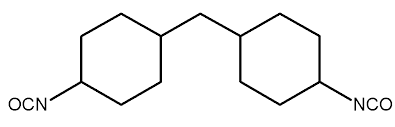
TPU from HDI and H12MDI

Patent Title: NON-SOFTENING RESILIENT THERMOPLASTIC POLYURETHANES

 Number/Link: WO2016/054320

Applicant/Assignee: Lubrizol

Publication date: 7-04-1016

Gist”: TPU from a blend of HDI and H12MDI has improved creep and wet modulus

Why it is interesting: Polymeric materials used for in vivo medical applications like catheters, need to be hydrolytically stable and retain physical properties like stiffness, resilience, flexibility etc. in wet conditions.  It is known that conventional TPUs based on aromatic or cyclo-aliphatic isocyanates tend to show some softening in aqueous environments. For this reason copolyamides (COPAs) and polyether-block-polyamides (PEBAs) are often preferred over TPU for use in medical devices.  According to this invention, TPUs that can replace COPA and PEBA in medical applications can be produced using a blend of 1,6-hexanediisocyanate (HDA) and H12MDI. In the examples polyether TPUs, prepared from 2000MW polytetramethyleneether diol, butanediol and a 19:1 HDI:H12MDI isocyanate blend at harblock contents ranging from 15 to 50%, convincingly show improved creep properties and wet modulus when compared to conventional TPU and a commercial PEBA material.

H12MDI

H12MDI