Hybrid Hotmelt Adhesive with Low Free Isocyanate

Title: POLYURETHANE HOT-MELT ADHESIVE HAVING A LOW CONTENT OF DIISOCYANATE MONOMERS AND GOOD CROSS-LINKING SPEED

 Number/Link: WO2015/135833 (German)

Applicant/Assignee: Sika

Publication date: 17-09-2015

Gist”: Use of mercaptosilane to reduce free monomeric diisocyanate

Why it is interesting: Reduction of the amount of free monomeric diisocyanate in adhesives, coatings, OCF systems etc. remains a hot topic in industrial polyurethane research, mostly because of changing legislation. For example, in the EU the amount of free MDI needs to be below 1% in order to avoid “R-40” (suspect carcinogen) labeling. A number of strategies to reduce free isocyanate have been tried in the past (and mentioned in this blog). Examples are distillation, the use of asymmetric diisocyanates and the use of monols. According to this invention the amount of free monomeric isocyanate in a hotmelt formulation can be reduced by adding a mercaptosilane like e.g. mercaptopropyltrimethoxysilane.  The mercaptosilane is said to react preferentially with the monomeric isocyanate.  Only a relatively small amount of mercaptosilane is used such that the main curing mechanism is still the isocyanate-water reaction.
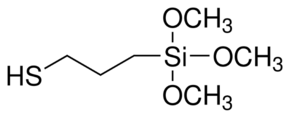
Mercaptopropyltrimethoxysilane
Mercaptopropyltrimethoxysilane


PU Sealants using Michael Addition Chemistry

Title: MICHAEL ACCEPTOR-TERMINATED URETHANE-CONTAINING FUEL RESISTANT PREPOLYMERS AND COMPOSITIONS THEREOF

 Number/Link: US2015/0252232

Applicant/Assignee: PRC-DeSoto

Publication date: 10-09-2015

Gist”: A PU prepolymer is capped with Michael accepting groups and then cured with a dithiol

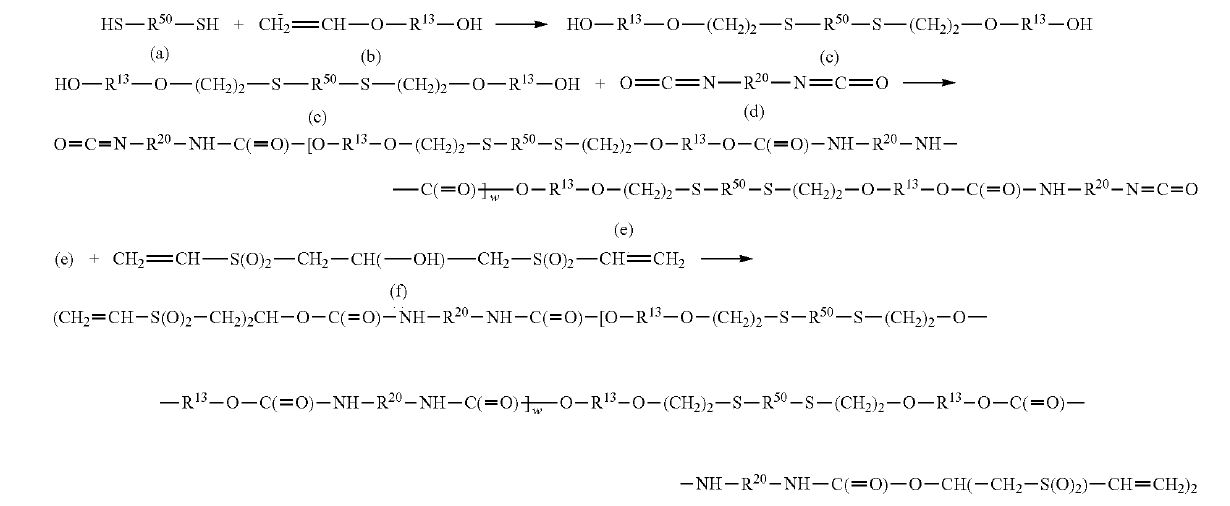
Why it is interesting: This invention is about sulphur containing PU sealants with properties acceptable for the aerospace industry. A bis(vinylsulfonyl)- terminated urethane-polythioether prepolymer is prepared according to the scheme below. The prepolymer can then be cured with a dithiol-ended polyether, catalysed by a tertiary amine.  The compositions have an extended pot life and the curing rate can be controlled by using an encapsulated tert-amine as a controlled-release catalyst.

Michael acceptor-terminated prepolymer preparation according to the invention

Michael acceptor-terminated prepolymer preparation according to the invention

Triptycene Chain Extenders

Title: TRIPTYCENE MONOMER AND TRIPTYCENE CONTAINING POLYESTERS AND POLYURETHANES

 Number/Link: US20150191408

Applicant/Assignee: not yet recorded. Research supported by US Army

Publication date: 9-07-2015

Gist”: A novel primary diol derived from triptycene is useful as chain extender for polyurethanes and polyesters.

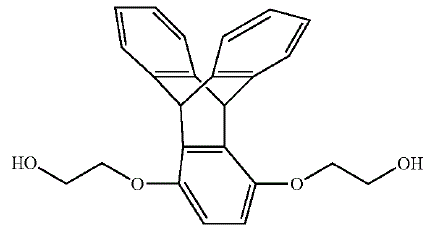
Why it is interesting: Polymers with increased mechanical properties and stiffness can be obtained by incorporating rigid structures in the polymer chain.  This however also results in increased glass transition temperature and reduced ductility because of reduced chain flexiblity and entanglements.  According to this invention polyurethanes (and copolyesters) with high modulus and good ductility at low temperatures can obtained by using triptycene-1,4-hydroquinone-bis(2-hydroxyethyl ether) or TD. In and example TD capped with PEG400 is reacted with a 4,4’MDI- PTMEG1000 prepolymer.  The resulting material indeed has a very low softblock Tg of  -65ºC and a much higher Y modulus compared to a PU made with HQEE as chain extender. According to the inventors the PU is highly suitable as a matrix material in KEVLAR or UHMWPE fiber composites.
In my opinion this is a very interesting chain extender as it appears to prevent H-bond formation and increase molar volume thereby substantially decreasing Tg. However lack of availability, and (most probably) price, will prevent this from becoming mainstream anytime soon.

Tryptycene-1,4-hydroquinone-bis(2-hydroxyethyl ether)

Triptycene-1,4-hydroquinone-bis(2-hydroxyethyl ether)


  • Pages

  • Categories

  • Enter your email address to follow this blog and receive notifications of new posts by email.

    Join 259 other subscribers
  • Follow Innovation in PU on Twitter