Polyurethane Dispersions with “Reversible Drying”

Title: RADIATION CURABLE AQUEOUS COMPOSITIONS WITH REVERSIBLE DRYING

 Number/Link: WO2014/111349

Applicant/Assignee: Allnex

Publication date: 24-07-2014

Gist”: PUDs from hydrophilic, low molecular weight PU can be re-dispersed after drying.

Why it is interesting: It is known that PUDs will coalesce into an insoluble film when dried, at least when the temperature is over the ‘minimum film forming temperature’ or MMFT.  This behaviour, while being useful in most coating- and adhesives applications, can be problematic when the PUDs are used for jet-printing inks because of irreverisble blocking of the print-head nozzles.  According to this invention re-dispersible PUDs can be made when the PU used is both sufficiently hydrophilic and of a low average molecular weight (pref. an Mn between 1000 and 5000, with a polydispersity between 2 and 4). The PU does need to be radiation curable so it can be crosslinked after drying.  In the examples a low NCO prepolymer is prepared from 1,6-hexanediisocyanate (HDI), 2,2-dimethylolpropionic acid, some polyester or polycarbonate polyol and an acrylic chainstopper like a propoxylated trimethylolpropane diacrylate. The (viscous) prepolymer is dispersed and neutralized by adding water containing NaOH or triethylamine. After drying the PUDs of the invention can be re-dispersed in water at 25°C.

Film-forming PU dispersion.
Film-forming PU dispersion.

Highly Stable Isocyanate Dispersions

Title: STORAGE-STABLE HYDROPHILIC POLYISOCYANATES

 Number/Link: WO2014/053269   (German)

Applicant/Assignee: Evonik

Publication date: 10-04-2014

Gist”: A uretdion-containing isocyanate prepolymer is reacted with a neutralized aminealkylsulfonic acid to produce a novel hydrophilic (latent) isocyanate which can be used in stable aqueous dispersions.

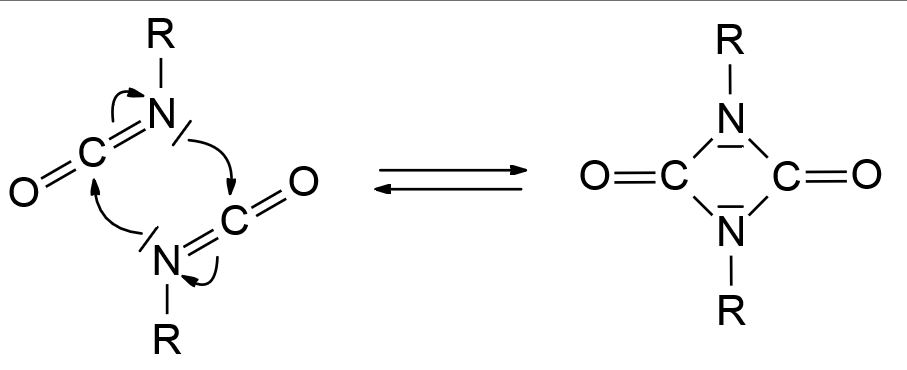
Why it is interesting: Aqueous dispersions of isocyanates are useful in many applications as adhesives, binders, crosslinkers etc, but usually suffer from a relatively short shelf life.  Dispersions prepared according to the current invention supposedly lose less than 30% of their initial NCO value after 12 weeks storage at 50°C. In an example an aceton-solution of  an IPDI-uretdion prepolymer with an isocyanate content of 1.5% is reacted with the sodium salt of an aminealkylsulfonate in water to an NCO value of 0.1%. After removal of the aceton the resulting dispersion had a latent isocyanate content of 4.5%

Dimerization of isocyanate to uretdion.

Reversible dimerization of isocyanate to uretdion.

Prepregs from Glass Fiber and Reactive Polyurethane Powder

Title: PREPREGS AND MOLDINGS PRODUCED THEREFROM

 Number/Link: US2014065911

Applicant/Assignee: Evonik

Publication date: 6-03-2014

Gist”: A reactive polyurethane powder is prepared from a mixture of a  solid polyester polyol and a solid dimerised IPDI and subsequently used to make glass fiber prepregs.

Why it is interesting:  A polyurethane powder is made from (pref.) a mixture of  a solid (at room temperature) polyster polyol and a solid, blocked isocyanate.  The isocyanate is preferably an “internally” blocked IPDI.  Internally blocked meaning that the isocyanate contains uretidinedione groups.  The powder is scattered over a fibrous support and heated to over melting temperature but below curing temperature to make the prepreg.  Prepregs made with PU powder instead of the conventional resins have the advantage of being non-sticky, non-toxic and of having a very high storage stability (45 days in the examples).

Prepreg production with reactive PU powder

Prepreg production with reactive PU powder

  • Pages

  • Categories

  • Enter your email address to follow this blog and receive notifications of new posts by email.

    Join 259 other subscribers
  • Follow Innovation in PU on Twitter