Renewable Polyols from “Distillers Grains”

Title: PRODUCTION OF POLYOLS USING DISTILLERS GRAINS AND PROTEINS AND LIGNIN EXTRACTED FROM DISTILLERS GRAINS

 Number/Link: US2014/200324

Applicant/Assignee: EMGPI PROC and PITTSBURG STATE UNIVERSITY 

Publication date: 17-07-2014

Gist”: Dried distillers grains are transamidated and then alkoxylated to form a polyol useful for rigid polyurethane spray foams.

Why it is interesting: ‘Distillers grains’ are a by-product of ethanol production and are currently avaible in huge quatities due to the state-sponsored bio-ethanol production in the US.  Most of the product is used as animal feeds because of the high levels of nutrients. Dried distillers grain (DDGS) contains about 30% protein, about 30% fibers (cellulose, hemicellulose and lignin) and about 30% lipids, ash and water. According to this invention DDGS can be turned into polyols by first reacting the (solid) DDGS with diethanolamine at elevated temperature and pressure (about 200°C and 3.5 MPa) and breaking down the proteins in amino-amides. The resulting liquid can subsequentlly be epoxidized with propylene oxide resulting in a polyol which is supposedly highly reactive and useful for polyurethane rigid spray foams.
Personally I find it hard to believe that a decent reproducible foam can be made with such a horrible mixture.
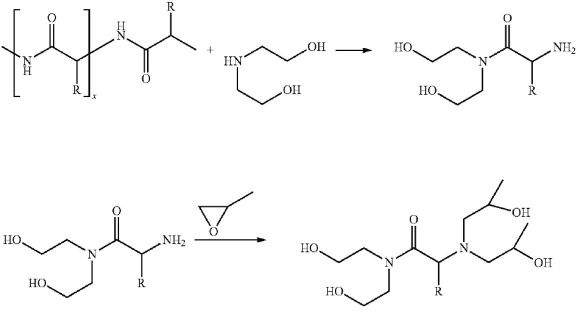
Transamidation of protein with subsequent epoxidation.

Transamidation of protein with subsequent epoxidation.

Improved “Black” Insulation Foams

Title: ISOCYANATE-BASED POLYMER FOAM COMPOSITE WITH IMPROVED THERMAL INSULATION PROPERTIES

 Number/Link: US20140151593

Applicant/Assignee: Dow

Publication date: 5-06-2014 (Priority PCT/US)

Gist”: Use of fluorinated carbon black to improve insulation value of rigid polyurethane foams

Why it is interesting: It is known that carbon black can be used to improve the insulation value of rigid foams by reducing the radiation component of the thermal conductivity. The carbon black however needs to have a very small particle size and needs to be extremely well dispersed into the reacting medium. According to the invention using a fluorinated carbon black improves the dispersion into the raw materials which, in turn, improves the final insulation value of the foam.
A small but valuable innovation.

Different grades of carbon black

Different grades of carbon black

Monolithic Polyurethane Aerogels

Title: POROUS POLYURETHANE NETWORKS AND METHODS OF PREPARATION

 Number/Link: US2014/147607

Applicant/Assignee: Aerogel Technologies

Publication date: 29-05-2014

Gist”: Monomeric tri-isocyanate and aromatic di- and triols dissolved in acetone and catalyzed by DBTDL form a gel which is supercritically dried into an aerogel.

Why it is interesting: Isocyanate-based aerogels have been reported before but because these are usually based on ‘industrial’ oligomeric raw materials like polymeric MDI and oligomeric polyols they have low mechanical properties. In the current invention, PU aerogels are prepared from monomeric tri-isocyanates (e.g. tris(isocyanatophenyl)methane) which is reacted with an aromatic triol (e.g. tris(hydroxyphenyl)ethane) and an aromatic diol (e.g.  bisphenol-A) and catalyzed by DBTDL.  The reaction takes place in anhydrous acetone which after gelation gets replaced by supercritical CO2.  The resulting nanoporous materials are high in density (200-700 kg/m3) with a compressive modulus of more than 50MPa and a thermal conductivity below 50mW/m.K .

A (silica) aerogel.

A (silica) aerogel.

  • Pages

  • Categories

  • Enter your email address to follow this blog and receive notifications of new posts by email.

    Join 259 other subscribers
  • Follow Innovation in PU on Twitter