Classic PU Patent of the Month: Scott Paper Co. on Reticulated Polyurethane Foams (1964)

Title: Reticulated polyurethane foams and process for their production

 Number/Link: US3171820

Applicant/Assignee: Scott Paper Co.

Publication date: 2-03-1965

Gist”: PU foams are reticulated by hydrolysis or explosion.

Why it is interesting:   Reticulated foams are foams from which the membranes have been removed so that only a three dimensional network of strands or ‘struts’ remains. These materials are commercially available in different grades of stiffness and porosity and are useful in applications such as filtering, sound absorbing, padding and the like. The current invention – filed in 1964 but a ‘continuation’ of an application filed in 1956- teaches the two processes to reticulate PU foam still in use today. The first process uses an aqueous NaOH solution to hydrolyse the cell membranes, in the second process a foam block is brought in an autoclave together with an explosive gas mixture (e.g. a mixture of oxigen and acetylene) which is then made to explode using a spark plug. When executed correctly the explosion removes all cell membranes leaving the struts intact. ‘Explosive recticulation’ is one of my all-time favorite PU inventions: simple, yet very effective and very courageous. In the current culture of hyper-safety where employees have to report paper-cuts, inventions like this are no longer possible.
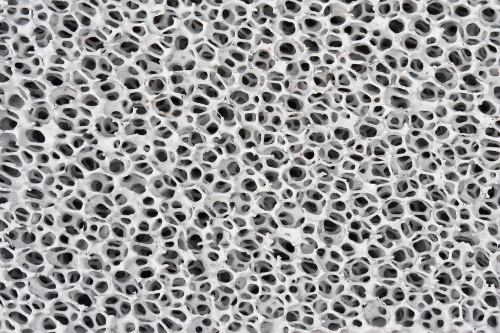
Recticulate polyurethane foam

A recticulated polyurethane foam

Hydrolysis Resistant Polyester Polyurethane

Title: A POLYESTER POLYURETHANE MATERIAL WITH LONG TERM HYDROLYSIS RESISTANCE

 Number/Link: WO2014114614

Applicant/Assignee: Bayer

Publication date: 31-07-2014

Gist”: Hydrolysis resistant polyurethane elastomers can be prepared from sterically hindered polyester polyols together with a perchlorate salt.

Why it is interesting: Because of their high mechanical properties and abrasion resistance, polyester-based polyurethane elastomers are a material of choice in e.g. the footwear and automotive industries. Main drawback however is their susceptibility to hydrolysis which causes loss of physical properties in moist environments.  According to the current invention, hydrolysis resistance can be greatly improved by using a specific polyester polyol together with a perchlorate salt (e.g. 0.3% sodium perchlorate on the total composition). The polyester polyol is based on a diacid (e.g. adipic acid) and a mixture of diols one of which contains alkyl side groups (e.g. a mixture of butanediol and neopentylglycol).
The invention is actually a combination of two known ‘tricks’:  the neopentyl glycol will introduce some hydrophobicity and steric hindrance into the polyester backbone, and the perchlorate may have a weak coordination with the hydrolysable ester bonds thus forming a steric protection layer (at least according to Bayer’s own WO2013/030147). Because both effects are known and published I doubt that this is patentable.

Neopentylglycol

Neopentylglycol

Ionic Liquids for Improved Hydrolysis Resistance of Polyester Polyurethanes

Title: HYDROLYSIS-RESISTANT POLYURETHANE MOULDED ARTICLES MADE OF POLYESTER POLYURETHANE

 Number/Link: WO2014/095438  (German)

Applicant/Assignee: BASF

Publication date: 26-06-2014

Gist”: Polyester polyurethane elastomers containing carbodiimides, together with an ionic liquid and an amine catalyst in a specific ratio, show improved hydrolysis resistance.

Why it is interesting: Polyester PU elastomers show higher mechanical properties compared to polyether elastomers but have have a much worse hydrolysis resistance.  It is well known that the hydrolysis resistance can be improved by using sterically hindered carbodiimides (commercially known e.g. as Stabaxol®).  This invention shows that hydrolysis resistance can be even more improved by using a specific molecular ratio (pref. 0.5 : 1 to 2 : 1)  of  ionic liquid to amine catalyst in combination with the carbodiimides. The effect is apparent from the examples where 1-ethyl-3-methylimidazolium ethylsulfate was used as ionic liquid together with ethylenediamine as catalyst.  No theory or explanation for the effect is given and it is not immediately clear to me how this interesting synergy works.

Ionic liquid as used in the invention

Ionic liquid as used in the invention