Thiol-Crosslinked Poly(hydroxyurethanes)

Title: METHOD FOR PRODUCING OR CURING POLYMERS USING THIOL-ENE POLYADDITION REACTIONS

Number/Link: W2017/081120

Applicant/Assignee:  Henkel

Publication Date: 18-05-2017

“Gist”: Unsaturated PHU are crosslinked using polythiols

Why it is interesting: The invention is about poly(hydroxyurethanes) (PHU) containing alkylene groups that are crosslinked using thiol-ene ‘click’ polyaddition reactions. The unsaturated PHU are first prepared by aminolysis of cyclocarbonates using unsaturated amines. In an example di-trimethylolpropane is converted to di-trimethylolpropanedicarbonate using ethylchloroformiate.  The di-TMPDC is then reacted with 3-aminopropylvinylether to prepare the PHU, which is then crosslinked using pentaerithritol-tetra(3-mecaptopropionate) in the presence of a photoinitiator and UV light.  The invention is said to be useful for isocyanate-free adhesive- and coating systems.
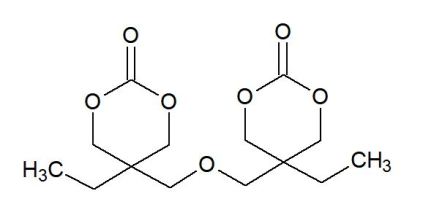
Di-trimethylolpropanedicarbonate

Bio-Based Acoustic Polyurethane Foam

Patent Title: POLYURETHANE MATERIALS FORMED FROM EPOXIDIZED PLANT OILS

 Number/Link: US2017/0081460

Applicant/Assignee: IBM

Publication date: 23-mar-2017

Gist”: Natural oils are converted into isocyanate-functional polyols and then polymerized

Why it is interesting: Epoxidized vegetable oils are hydrolized and saponified using NaOH, resulting in a mixture of acid-ended polyols. The acid groups are then converted into azides using diphenylphosphoryl azide, which then rearrange into isocyanate groups (Curtius rearrangement).  The isocyanate-ended polyols can be polymerized and further crosslinked using di-isocyanates. The materials are said to be useful as components for acoustic foams, used e.g. in mainframe computers.
This is the second IBM PU patent discussed in this blog. However, I doubt if they have an actual chemistry lab since their examples are “prophetic” rather than real.

IBM

Reaction scheme according to the invention

Non-Isocyanate Poly(Amide-Hydroxyurethanes)

Patent Title: NON-ISOCYANATE POLYURETHANES AND METHODS OF MAKING AND USING THE SAME

 Number/Link: WO 2017/ 030880

Applicant/Assignee: ELEVANCE RENEWABLE SCIENCES

Publication date: 23-feb-2017

Gist”: Telechelic cyclocarbonate-alkylesters are reacted with diamines in the melt

Why it is interesting: According to this invention (ω-) unsaturated alkylesters can be converted to mono-cyclocarbonate alkylesters and then reacted with diamines to prepare thermoplastic poly(amide-hydroxyurethanes) (PAHU). For example methyl-9-decenoate was first epoxidized and then reacted with CO2 to produce 9,10-cyclic carbonate-methyl decanoate. After separation and washing the cyclocarbonate was reacted – in the melt- with a mixture of dodecane diamine and a PTMO diamine (Jeffamine THF-100). It is said that the unsaturated alkylesters can be prepared from natural oils using (cross- or self-) metathesis followed (or preceded) by transesterifaction with alkanols.

PAHU preparation scheme

PAHU preparation scheme

  • Pages

  • Categories

  • Enter your email address to follow this blog and receive notifications of new posts by email.

    Join 259 other subscribers
  • Follow Innovation in PU on Twitter