Flexible Foams from Renewable Polyester Polyols

Title: METHOD FOR PRODUCING SOFT POLYURETHANE FOAM BASED ON POLYESTER POLYOLS

 Number/Link: WO2014/064130

Applicant/Assignee: Bayer

Publication date: 1-05-2014

Gist”: Flexible foams can be prepared from polyester polyols based on two different diacids and with a limited ester group content.

Why it is interesting: According to this invention flexible foams can be based on polyester polyols only if the polyols are not too polar or too ‘symmetrical’. This is achieved by preparing the polyols from at least two diacids chosen from (preferably) succinic-, adipic-, azeleic- or sebacic acid,  together with (e.g.) diethylene grlycol and some trimethylolpropane. Both the acids and the alcohols are preferably bio-based. The polyester polyols have an OH value of about 60 and an ester group content (polarity) of less than 9.8 mol/kg.  In comparative examples flexible foams based on polyester polyols containing only one diacid showed collapse.
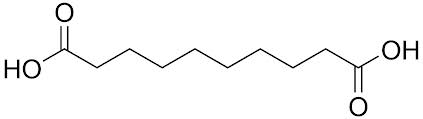
Sebacic Acid

Sebacic Acid

“Green” Isocyanate: Renewable and Phosgene-Free

Title: POLYISOCYANATES FROM FUSED BICYCLIC POLYOLS AND POLYURETHANES THEREFROM

 Number/Link: WO2014/062631

Applicant/Assignee: IOWA STATE UNIVERSITY

Publication date: 24-04-2014

Gist”: Isocyanates from acyl azides derived from isosorbide

Why it is interesting:  Fused bicyclic polyols are reacted with anhydrides to form polyacids which are converted to acyl halides which in turn are converted to acyl azides.  The acyl azides rearrange to isocyanates (Curtius Rearragment).  For example isosorbide is reacted with succinic anhydride, then with thionylchloride (SOCl2) to form the di-acylchloride and then with sodium azide (NaN3) to form the di-acylazide which rearranges into the di-isocyanate under liberation of nitrogen. The isocyanate can be reacted with more isosorbide to form a polyurethane. Clever chemistry but hard to judge if it is industrially viable.

Completely renewable polyurethane according to the invention . Click to enlarge.


Polyurethane Foam Containing Iron Particles for Improved Oil Absorption

Title: ABSORBENT MATERIAL

 Number/Link: WO2014/008554

Applicant/Assignee: Advanced Simplicity Technologies

Publication date: 16-01-2014

Gist”: Incorporation of iron particles improves the oil-absorbing capacity of PU foams.

Why it is interesting: The mineral-oil absorbing capacity of PU foam is well known and documented (see e.g. WO/1995/031402  and WO/1999/005066 ).  Current invention claims that the oil absorbing capacity of the foam can be greatly improved by incorporating inorganic particles, esp. metallic iron or silica. The particle size of the particles is chosen such as to protrude the foam cell walls so that they are exposed inside the foam pores (pref. 50 to 200μm). In an example an MDI-based  foam containing 70% (w/w) of iron powder was shown to absorb about 10g of oil per gram of foam.

Oils Spill at Sea

Oils Spill at Sea

  • Pages

  • Categories

  • Enter your email address to follow this blog and receive notifications of new posts by email.

    Join 259 other subscribers
  • Follow Innovation in PU on Twitter