Liquid Crystalline Polyurethane Elastomers

Patent Title: LIQUID CRYSTALLINE POLYURETHANE ELASTOMER AND METHOD FOR PRODUCING SAME

 Number/Link: US 2016/0376396

Applicant/Assignee: Toyo Tire & Rubber

Publication date: 29-dec-2016

Gist”: Specific mesogenic diols are used together with high MW polyols and high functionality isocyanate

Why it is interesting: The invention is about thermotropic liquid crystalline PU elastomers, where the liquid crystalline (LC) phase is formed at relatively low temperatures (e.g. near room temperature). This is accomplished by preventing the mesogen to crystallize, such that it shows no melting point between its Tg and Ti (LC phase -to- isotropic phase transition temperature). This, in turn, is accomplished by using a high molecular weight polyol together with a high functionality isocyanate and a mesogenic diol of the structure shown below where Y represents -N=N-, -CO-, -CO-O- or -CH=N- and X represents a C3 to C20 alkylene.  Under stress the elastomer extends in the orientation direction by increasing the LC content and shrinks by reducing LC content.  It can therefore be used as a temperature-controlled actuator.

General structure of the mesogenic diol of the invention
General structure of the mesogenic diol of the invention

TPU/PU-Acrylate Semi-IPNs

Patent Title: THERMALLY STABLE MICROSTRUCTURED SEMI-IPN LAYER

 Number/Link: WO2016/191118

Applicant/Assignee: 3M

Publication date: 1-dec-2016

Gist”:  TPU and PU-acrylate oligomers are blended and radiation-cured

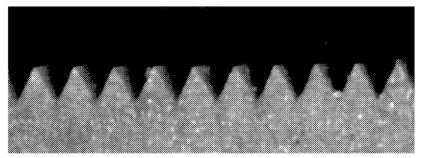
Why it is interesting: According to this invention semi-interpenetrating polymer networks (IPNs) that are prepared from thermoplastic polyurethane (or urethane/urea) and acrylate-functional polyurethane oligomers are highly heat-stable and abrasion resistant and can be used for the production of microstructured surfaces.  Microstructured (‘riblet’) surfaces with dimples or ridges of a few to a few hundred microns deep are used as drag reducing coatings on planes, ships and in aeronautics. In the examples 90% of a commercial TPU is blended and co-extruded with 10% of a commercial aliphatic urethane acrylate oligomer.  The extruded film was then laminated on on a microreplicated liner, radiation cured and removed from the liner to produce the riblet surface.

Microstructured layer according to the invention

Microstructured layer according to the invention

Soft Ionomeric TPU

Patent Title: SOFTENING THERMOPLASTIC POLYURETHANES USING IONOMER TECHNOLOGY

 Number/Link: US20160347900

Applicant/Assignee: Univ. Akron; Covestro

Publication date: 1-Dec-2016

Gist”: TPU is prepared with ionomeric groups having bulky counter-ions

Why it is interesting: According to this invention a novel type of plasticized thermoplastic polyurethane can be made  by incorporating as chain extender a diol containing an ionic group with a bulky counter ion. It is said that the steric hindrance of the bulky counter ions creates additional free volume that softens the polymer and lowers the melt viscosity. In the examples N,N-bis(2-hydroxyethyl)-2-aminoethane sulfonic acid (BES) is used together with bulky alkylammonium cations. The softest TPU shown has a 37 Shore A hardness at 25% hardblock content and 7.6 mole% BES-tetrakis(decyl)ammonium. This accounts for a 35 point hardness decrease compared to an ionomer-free control sample.

N,N-bis(2-hydroxyethyl)-2-aminoethane sulfonic acid

N,N-bis(2-hydroxyethyl)-2-aminoethane sulfonic acid

  • Pages

  • Categories

  • Enter your email address to follow this blog and receive notifications of new posts by email.

    Join 259 other subscribers
  • Follow Innovation in PU on Twitter