TPU from Low Free Monomeric Isocyanate Prepolymers

Title: THERMOPLASTIC POLYURETHANE FROM LOW FREE MONOMER PREPOLYMER

 Number/Link: WO2014/186111

Applicant/Assignee: Chemtura

Publication date: 20-11-2014

Gist”: TPUs with exceptional properties are produced from “full” prepolymers with a very low free monomeric isocyanate content.

Why it is interesting: According to this invention thermoplastic polyurethanes with improved processing characteristics and with exceptional mechanical-, fatigue- and ageing properties can be produced by reacting a ‘full’ prepolymer having a low ( less than 0.5% ) free monomeric isocyanate content with a low molecular weight chain extender. PPDI and MDI prepolymers with low free monomeric isocyanate can be prepared e.g. by distillation of the prepolymer in the presence of a inert solvent with a boiling point slightly lower than the monomeric diisocyanate present (see e.g. US2009/0076239). Products like this are commerically available. The reason for the exceptional properties is undoubtedly the result of a very regular microphase structure of these TPUs.
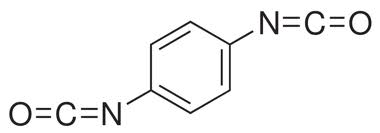
para-phenylenediisocyanate (PPDI)

para-phenylenediisocyanate (PPDI)

Poly (Urethane-Urea) Elastomers from High 2,6-TDI

Title: Polyurethane Elastomers Based on TDI Prepolymers Enriched in the 2,6-TDI Isomer Cured with Trimethylene Glycol Di-(para Amino Benzoate)

 Number/Link: US2014/0309397

Applicant/Assignee: Anderson Development

Publication date: 16-10-2014

Gist”: Elastomers are prepared from TDI containing a high amount of the 2,6 isomer.

Why it is interesting: Commercially available toluene diisocyanate (TDI) usually comes in the 80/20 or the 65/35  2,4/2,6 isomer blend. It is known that higher 2,6 levels result in stiffer hardblocks and a different reaction profile because of the (initially) equal reactivity of the isocyanate groups. According to this invention elastomers prepared from TDI with a 2,6 content of (most preferred) at least 60% results in superior green strength and dimensional stability. High 2,6 TDI-PTMEG prepolymers cured with trimethylene glycol di(p-aminobenzoate) (TGDBA) should even have a superior tear strength and upper hardness limit compared to MDI based elastomers.

TGDBA

TGDBA

Renewable Polyurea from Lysinol

Title: NEW POLYMERS DERIVED FROM RENEWABLY RESOURCED LYSINOL

 Number/Link: US2014/275311

Applicant/Assignee: Du Pont

Publication date: 18-09-2014

Gist”: Use of lysinol as renewable monomer for nitrogen-containing polymers including polyurea.

Why it is interesting: Lysinol or 2,5-diamino-1-hexanol is an amino alcohol derived from the amino acid lysine by  hydrogenation.  Lysine itself is produced by fermentation from sugars.  Annual production of lysine is apparently in excess of 1 million tonnes and its derivative lysinol is therefore considered as a potentially interesting biorenenawable monomer for a number of nitrogen-containing polymers. This patent application claims lysinol-based polyamides, polyimides, polyureas and “urethane crosslinked” polyureas including foams. In the examples urethane-polyureas are produced by reacting lysinol with hexamethylenediisocyanate using DABCO as catalyst.

Preparation of the two lysionol enantiomers from lysine.

Preparation of the two lysinol enantiomers from lysine.

  • Pages

  • Categories

  • Enter your email address to follow this blog and receive notifications of new posts by email.

    Join 259 other subscribers
  • Follow Innovation in PU on Twitter