Solid Cast Polyurethane Elastomers Produced with a Highly Specific “Switchable” Catalyst

Title: POLYISOCYANATE POLYADDITION PRODUCTS, A PROCESS FOR PREPARATION THEREOF AND USE THEREOF

 Number/Link: US2013/303720

Applicant/Assignee: Bayer

Publication date: 14-11-2013 (priority PCT/DE)

Gist”: Use of specific acid-bocked amidines as thermo-latent catalysts for cast elastomers.

Why it is interesting: For the production of solid (non-foamed) cast elastomers it is advantageous to use catalysts which specifically promote the NCO – OH reaction and as little as possible side reactions such as NCO – water, dimerization, trimerization, allophanatization etc. It is also advantageous that the catalyst can be ‘switched on’ at a certain temperature so that elastomer systems with a long open time and short cure time can be formulated. According to the current invention this can be accomplished by using an acid blocked amidine, pref. 1,8-diazabicyclo[5.4.0]undec-7ene (DBU) blocked with (pref.) isocrotonic acid (Z-2-butenoic acid), together with a zeolite as water scavenger. The system has the added advantage that no heavy metals are used.

1,8-Diazabicyclo[5.4.0]undec-7-ene (DBU)

1,8-Diazabicyclo[5.4.0]undec-7-ene (DBU)
Flexible Foams with Improved Humid-Aged Properties

Title: POLYURETHANE FOAM PRODUCTION PROCESS, PRE-MIX, FORMULATION, AND PRODUCT

 Number/Link: WO2013/143129

Applicant/Assignee: Air Products

Publication date: 3-10-2013

Gist”: Use of halohydrins as an additive in flexible foam formulations improves humid aged properties.

Why it is interesting: Properties of flexible polyurethane foams after humid-ageing appear to greatly improve when about 0.5 to 1 pphp of a halohydrin is added to the formulation.  “Halohydrin” is in this case used as a synonym for halo-alcohol. Mentioned are 2-(2-chloroethoxy)ethanol, 2,2-dichloroethanol and 1-chhloro-6-hexanol e.g. According to the examples the effect appears to be real and most pronounced for mechanical properties after humid ageing viz. tensile and elongation properties. It is not immediately clear to me what the underlying mechanism could be.

Chloroethoxyethanol

Chloroethoxyethanol

Polyurethane Prepregs prepared with Isosorbide

Title: STORAGE-STABLE POLYURETHANE-PREPREGS AND FIBRE COMPOSITE COMPONENTS PRODUCED THEREFROM

 Number/Link: WO2013/139704

Applicant/Assignee: Bayer

Publication date: 26-09-2013

Gist”: Polyurethane matrix materials for prepregs with very good storage stability are prepared from an NCO prepolymer together with isosorbide and delayed action catalysts.

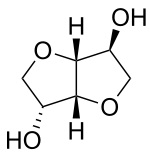
Why it is interesting: Resins for “prepregs” (pre-impregnated fibre composites) need to have a low viscosity upon impregnation, a good storage stability and a fast ‘curing’ reaction preferably at a relatively low temperature.  According to this invention all these properties can be met by using a 8-16% NCO prepolymer made from a polyester polyol and  MDI, together with a dianhydrohexitol (preferably isosorbide) as chain extender and a delayed action catalyst (e.g. a blocked amine) which is activated between 50 and 100°C. The resulting prepregs have a storage stability at room temperature of several weeks. Final Tg is said to be 130°C, which is not very high but should suffice for many applications.

Isosorbide

Isosorbide

  • Pages

  • Categories

  • Enter your email address to follow this blog and receive notifications of new posts by email.

    Join 259 other subscribers
  • Follow Innovation in PU on Twitter