Isocyanate-Free Polyurethanes Using Azide-Alkyne Click Chemistry

Title: SYNTHESIS OF POLYURETHANE POLYMERS VIA COPPER AZIDE-ALKYNE CLICK CHEMISTRY FOR COATINGS, ADHESIVES, SEALANTS AND ELASTOMER APPLICATIONS

 Number/Link: WO2014/122153

Applicant/Assignee: Sika

Publication date: 14-08-2014

Gist”: Polyurethane prepolymers capped with azides and alkynes are reacted using copper catalysis.

Why it is interesting: Because of safety, health and envriromental issues, isocyanate-free systems have clearly been gaining in importance the last few years.  Especially for coatings, adhesives and OCF applications, alternative curings systems are being developed. In the current invention an isocyanate-free system is based on the reaction between a prepolymer having at least two azide groups and a prepolymer having at least two alkyne groups. The reaction is copper catalyzed such that it can be performed at ambient temperature. The first prepolymer is (pref.)  prepared by reacting an isocyanate ended prepolymer with glycidol (2,3-epoxy-1-propanol) and subsequently with sodium azide. The second prepolymer is similarly prepared by reacting an isocyanate ended prepolymer with propargyl alcohol (2-propyn-1-ol).  The systems are said to be especially useful for roof coatings.

Example of an azide-alkyne reaction resulting in 1,4-disubstituded triazoles.

Example of an azide-alkyne reaction resulting in 1,4-disubstituded triazoles.


Ionic Liquids for Improved Hydrolysis Resistance of Polyester Polyurethanes

Title: HYDROLYSIS-RESISTANT POLYURETHANE MOULDED ARTICLES MADE OF POLYESTER POLYURETHANE

 Number/Link: WO2014/095438  (German)

Applicant/Assignee: BASF

Publication date: 26-06-2014

Gist”: Polyester polyurethane elastomers containing carbodiimides, together with an ionic liquid and an amine catalyst in a specific ratio, show improved hydrolysis resistance.

Why it is interesting: Polyester PU elastomers show higher mechanical properties compared to polyether elastomers but have have a much worse hydrolysis resistance.  It is well known that the hydrolysis resistance can be improved by using sterically hindered carbodiimides (commercially known e.g. as Stabaxol®).  This invention shows that hydrolysis resistance can be even more improved by using a specific molecular ratio (pref. 0.5 : 1 to 2 : 1)  of  ionic liquid to amine catalyst in combination with the carbodiimides. The effect is apparent from the examples where 1-ethyl-3-methylimidazolium ethylsulfate was used as ionic liquid together with ethylenediamine as catalyst.  No theory or explanation for the effect is given and it is not immediately clear to me how this interesting synergy works.

Ionic liquid as used in the invention

Ionic liquid as used in the invention

Improved P.I.P. Foams

Title: Foam Composition and its Uses Thereof

 Number/Link: US2014/079940

Applicant/Assignee: MAS RES AND INNOVATION PVT

Publication date: 20-03-2014 (priority PCT)

Gist”: Use of 4 catalysts:  2 ‘normal’ and 2 ‘delayed action’ are used to formulate pour-in-place foams that resist fabric penetration.

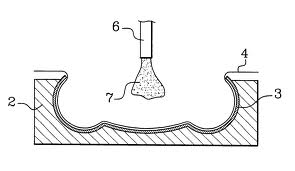
Why it is interesting: “Pour in place” or “in situ” foaming is a technique where a flexible foam-forming mixture is poured directly onto fabric to (typically) produce car seats. The fabrics used are often laminated with a thermoplastic film or a layer of polyester PU foam to prevent penetration of the foaming mixtures.  These liners however impair breathability and therefore comfort. The current invention should allow use of liner-free fabrics without strike through. Four different catalysts are used:  a normal gelling catalyst, a normal blowing catalyst a delayed action gelling catalyst and a delayed action blowing catalyst. The delayed action catalysts are conventional amine catalysts reacted with a suitable acid like lactic acid and become active at a temperature of around 50°C. When poured on a fabric-lined and heated mould, a flexible foam mixture formulated with these catalysts should gel imediately and not penetrate the fabric.

Pour-in-place technique:  2: mould, 3 fabric, 7 foam forming mixture.

Pour-in-place technique: 2: mould, 3 fabric, 7 foam forming mixture.

  • Pages

  • Categories

  • Enter your email address to follow this blog and receive notifications of new posts by email.

    Join 259 other subscribers
  • Follow Innovation in PU on Twitter