Reactive Cellopener for Polyurethane Rigid Foams

Title: REACTIVE CELL OPENER COMPOSITION, POLYOL COMPOSITION, AND OPEN-CELLED POLYURETHANE FOAM

 Number/Link: US2014/0231708

Applicant/Assignee: LG Electronics

Publication date: 21-08-2014

Gist”:  A silicon oil together with the lithium-salt of 12-hydroxystearic acid is used as cellopener for rigid VIP foams.

Why it is interesting: While coventional rigid insulation foams are closed-celled, rigid foams for use in vacuum insulation panels (VIPs) need to have a very high open cell content together with a cell size which is as small as possible. The current invention relates to reactive cellopeners comprising a silicone ‘base’ oil and the metal salt of a fatty acid having a (isocyanate-reactive) hydroxy group.  In an example the Li-salt of of 12-hydroxystearic acid is produced from LiOH and the fatty acid using a silicone oil as reaction medium. The composition, having a 30% solids content, is then used as a cellopener in a rigid foam formulation resulting in a cell size of about 90μm and 98% open cell content at a density of about 50 kg/m³. A perfluoroalkane nucleating agent was used as well.
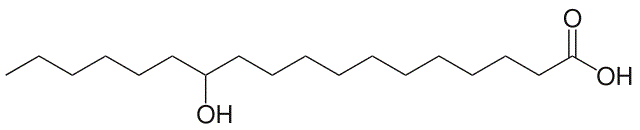
12-hydroxystearic acid

12-hydroxystearic acid


Using PU Foams as a Template for Silicone Foams

Title: FOAM-LIKE MATERIALS AND METHODS FOR PRODUCING SAME

 Number/Link:US2014/154491

Applicant/Assignee: Allergan

Publication date: 5-06-2014 (priority PCT/US)

Gist”: A polyurethane foam is impregnated with a curable liquid silicone.  After curing of the silicone the PU is removed.

Why it is interesting: According to this invention open celled polyurethane (or melamine) foam structures can be ‘converted’ into other materials like silicone, polyesters, polyolefins etc. by impregnating them with the the appropriate raw materials, curing and removing the ‘base’ foam. Optionally the ‘converted’ foam structure can be impregnated and cured again until the desired porosity is obtained.  In an example a PU foam was impregnated with a HTV silicone rubber.  After curing, the PU structure was removed using hydrogen peroxide.
While undoubtedly very interesting foam materials can be made in this way, the process seems messy and not very practical.

A 'base foam structure' (left has been impregnated and cured with another polymer (right).

A ‘base’ foam (left) and an impregnated foam (right) according to the invention.


Monolithic Polyurethane Aerogels

Title: POROUS POLYURETHANE NETWORKS AND METHODS OF PREPARATION

 Number/Link: US2014/147607

Applicant/Assignee: Aerogel Technologies

Publication date: 29-05-2014

Gist”: Monomeric tri-isocyanate and aromatic di- and triols dissolved in acetone and catalyzed by DBTDL form a gel which is supercritically dried into an aerogel.

Why it is interesting: Isocyanate-based aerogels have been reported before but because these are usually based on ‘industrial’ oligomeric raw materials like polymeric MDI and oligomeric polyols they have low mechanical properties. In the current invention, PU aerogels are prepared from monomeric tri-isocyanates (e.g. tris(isocyanatophenyl)methane) which is reacted with an aromatic triol (e.g. tris(hydroxyphenyl)ethane) and an aromatic diol (e.g.  bisphenol-A) and catalyzed by DBTDL.  The reaction takes place in anhydrous acetone which after gelation gets replaced by supercritical CO2.  The resulting nanoporous materials are high in density (200-700 kg/m3) with a compressive modulus of more than 50MPa and a thermal conductivity below 50mW/m.K .

A (silica) aerogel.

A (silica) aerogel.

  • Pages

  • Categories

  • Enter your email address to follow this blog and receive notifications of new posts by email.

    Join 259 other subscribers
  • Follow Innovation in PU on Twitter