Dispersions of Comb-Structured Polyurethanes

Patent Title: POLYURETHANE-BASED BINDER DISPERSION

 Number/Link: WO2016122569

Applicant/Assignee: Hewlett-Packard

Publication date: 4-08-2016

Gist”:  Aqueous dispersions of “1,2”-dihydroxypolyacrylate -based polyurethanes

Why it is interesting: According to this invention aqueous dispersions can be made of “comb -structured” polyurethanes which are based on polyols having two hydroxyl groups at one end of the chain.  The “1,2”-diols are made by copolymerizing (e.g.) methylmethacrylate and n-butylmethacrylate together with thioglycerol up to a Mw of about 2000. The polyols can then be reacted with isocyanate and dimethylolpropionic acid for dispersion in water. The dispersions are said to have a small average particle size (10-100 nm) and be especially useful as binders for inkjet-ink.

Thioglycerol
Thioglycerol

PET-Lignin Polyols

Patent Title: HIGH RECYCLE CONTENT POLYOLS FROM THERMOPLASTIC POLYESTERS AND LIGNIN OR TANNIN

 Number/Link: WO2016/118411

Applicant/Assignee: Resinate Materials Group

Publication date: 28-07-2016

Gist”: PET is glycolized and then reacted with lignin or tannin

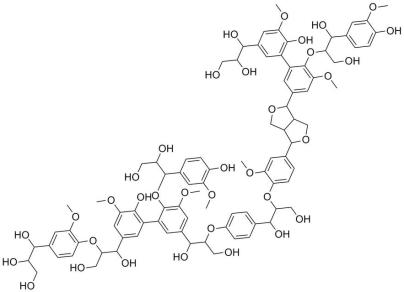
Why it is interesting: This application is about ‘sustainable’ aromatic polyester polyols partly based on recycled materials and partly on biorenewable materials. According to the invention the polyols can be prepared by first glycolizing (waste) PET and subsequently reacting the mixture with lignin at 110-210°C while removing volatile condensation products.  The resulting polyols (pref) show a OH value between 40 and 400 mg KOH/g, a fn of 2-2.2 and a viscosity at 25°C of 500 to 3000 cP. In the examples polyols with up to 25 wt% lignin are shown. The polyols are said to be useful e.g. in 2K PU coating compositions.

Part of a lignin structure

Part of a lignin structure

Optical Polyurethane Elastomers

Patent Title: COMPOSITION FOR TRANSPARENT SHAPED BODIES BASED ON POLYURETHANE

 Number/Link: WO2016/113295

Applicant/Assignee: Covestro

Publication date: 21-07-2016

Gist”: Use of amino-chelate-tin complex as delayed action catalyst for transparent PU elastomers

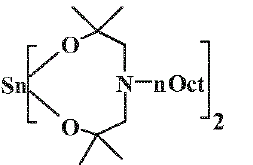
Why it is interesting: Lenses for eyeglasses are increasingly made from transparent organic polymers like polyurethane elastomers. The production requires a specialized casting process into glass moulds, followed by an exact tempering over many hours. According to this invention polyurethane elastomers, useful for the production of eyeglass lenses, can be made form a composition containing a polyol, a cycloaliphatic or araliphatic diisocyanate, an internal mould release agent and a thermo-latent catalyst. The catalyst is an inorganic metal complex comprising Sn (preferred) and at least one tert-amine containing chelating ligand. The composition is said to have a longer ‘open-time’ as the catalyst-free system.

Example of thermo-latent catalyst according to the invention

Example of thermo-latent catalyst according to the invention

  • Pages

  • Categories

  • Enter your email address to follow this blog and receive notifications of new posts by email.

    Join 259 other subscribers
  • Follow Innovation in PU on Twitter