TPU from Gem-Dialkyl Cyclooctene

Patent Title: TELECHELIC PREPOLYMERS AND REACTION PRODUCTS THEREOF

 Number/Link: WO 2017/023506

Applicant/Assignee: University of Minnesota

Publication date: 9-feb-2017

Gist”:  Diols are made by ROM polymerization of gem-dialkyl cyclooctene together with a symmetrical diol as chain transfer agent

Why it is interesting: According to this application, thermoplastic polyurethanes containing geminal dialkyl groups have far superior thermal stability, oxidative-, hydrolytic- and barrier properties as compared to TPUs containing conventional soft segments. Diols containing gem-dialkyl groups are prepared by ring-opening metathesis polymerization (ROMP) of a gem-dialkyl cyclooctene with a suitable catalyst and in the presence of a symmetrical aliphatic olefin chain transfer agent having functional end groups. Examples are 5,5-dimethylcyclooct-1-ene and 1,8-oct-4-ene diol as the chain transfer agent.  The resulting diol is then reacted with (e.g.) 4.4′-MDI to prepare the TPU.
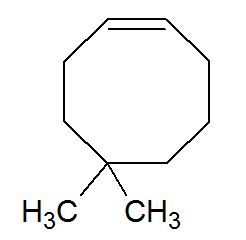
5,5-dimethylcyclooct-1-ene

5,5-dimethylcyclooct-1-ene

TPU-Silicone TPVs

Patent Title: THERMOPLASTIC POLYURETHANE COMPOSITE MATERIAL COMPOSITION, THERMOPLASTIC POLYURETHANE COMPOSITE MATERIAL AND MANUFACTURING METHOD THEREOF, SHOE MATERIAL AND WEARABLE APPARATUS

 Number/Link: US2017 /0015825

Applicant/Assignee: Evermore Chem. Ind.

Publication date: 19-jan-2017

Gist”: A blend of TPU and unsaturated silicone gum is dynamically vulcanized

Why it is interesting: A thermoplastic polyurethane is blended (in a kneader) with 1 to 5% w/w of double-unsaturated silicone rubber gum. The blend is then dynamically vulcanized by extruding (and pelletizing) it together with a peroxide curing agent like e.g. 1,3-bis-(t-butylperoxyisopropyl)benzene. The resulting thermoplastic is said to have improved slip resistance without reducing the TPU properties like abrasion resitance and is therefore said to be especially useful for the production of shoe-soles. It is ‘contemplated’ that the resulting material is a semi-IPN, but (i.m.o.) it is more likely that a seperate crosslinked silicone  phase -and therefore a thermoplastic vulcanizate (TPV)- is formed.

perox

1,3-bis-(t-butylperoxyisopropyl)benzene

TPU with Anti-Biofouling Surface

Patent Title: ANTIFOULING COMPOSITION

 Number/Link: WO2017/007899

Applicant/Assignee: BASF

Publication date: 12-jan-2017

Gist”: TPU containing silicone diol and having microstructured surface

Why it is interesting: Biofouling of surfaces e.g. in the marine environment or of medical implants is a problem.  For example the growth of barnacles on the hulls of vessels, subsea cables, pipes and energy generating structures has a significant economic impact. According to this invention, thermoplastic polyurethane articles with a surface energy of about 20 mN/m and a microstructered surface topography show an improved resistance to biofouling. The TPU is produced by incorporating 5-15% on the total composition of a PDMS diol with a OH value of 15 to 150, and by pressing onto the surface a 3D topology with ‘peaks’ and ‘valleys’ of an order of magnitude of 10μm.

Microstructured surface according to the invention

Microstructured surface according to the invention

  • Pages

  • Categories

  • Enter your email address to follow this blog and receive notifications of new posts by email.

    Join 259 other subscribers
  • Follow Innovation in PU on Twitter