PPE-Filled Rigid Foams

Title: RIGID FOAM AND ASSOCIATED ARTICLE AND METHOD

 Number/Link: WO2015/012989

Applicant/Assignee: SABIC

Publication date: 29-01-2015

Gist”: Rigid polyurethane foams containing polyphenylene ether particles

Why it is interesting: This invention is about rigid PU or PIR (polyisocyanurate) foams containing up to 25% w/w on the total composition of poly(2,6-dimethyl-1,4-phenylenether) particles.  The particles have a mean particle size of about 6 µm and are prepared by jet milling a commercial grade of PPE powder. The resulting foams are said to have reduced flammability and water absorption.  This is the second patent application that SABIC files on PPE-PU hybrids or combinations.  An interesting development but it is hard to believe that these ideas are practical and economical.

poly(2,6-dimethyl-1,4-phenyleneether)

poly(2,6-dimethyl-1,4-phenylene ether)

Thermal Engine Encapsulation with Polyurethane Foam

Title: THERMAL INSULATION OF AN INTERNAL COMBUSTION ENGINE

 Number/Link: WO2014/195153 (German)

Applicant/Assignee: BASF

Publication date: 11-12-2014

Gist”:  Engine parts are encapsulated in PU foam using moulds.

Why it is interesting: Encapsulating (part of) motor car engines with heat-insulating rigid PU foam is useful because it can reduce fuel consumption and exhaust. When the mass of the foam is increased (e.g. by filling with BaSO4) the encapsulation can also reduce noise levels. BASF has been working on this concept for more than 15 years now (see e.g. DE19935335) and the current application only relates to a process improvement:  an engine part is brought into a closed mould leaving a gap between part and mould which is then filled with PU foam. This is an interesting concept but I wonder if it is actually used in current motor cars.  And if not, why not?

Car with thermally encapsulated engine.

Car with thermally encapsulated engine.


Reactive Cellopener for Polyurethane Rigid Foams

Title: REACTIVE CELL OPENER COMPOSITION, POLYOL COMPOSITION, AND OPEN-CELLED POLYURETHANE FOAM

 Number/Link: US2014/0231708

Applicant/Assignee: LG Electronics

Publication date: 21-08-2014

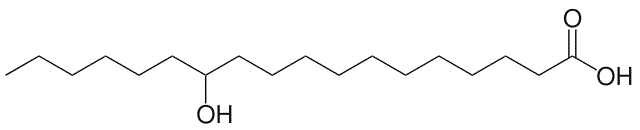
Gist”:  A silicon oil together with the lithium-salt of 12-hydroxystearic acid is used as cellopener for rigid VIP foams.

Why it is interesting: While coventional rigid insulation foams are closed-celled, rigid foams for use in vacuum insulation panels (VIPs) need to have a very high open cell content together with a cell size which is as small as possible. The current invention relates to reactive cellopeners comprising a silicone ‘base’ oil and the metal salt of a fatty acid having a (isocyanate-reactive) hydroxy group.  In an example the Li-salt of of 12-hydroxystearic acid is produced from LiOH and the fatty acid using a silicone oil as reaction medium. The composition, having a 30% solids content, is then used as a cellopener in a rigid foam formulation resulting in a cell size of about 90μm and 98% open cell content at a density of about 50 kg/m³. A perfluoroalkane nucleating agent was used as well.

12-hydroxystearic acid

12-hydroxystearic acid


  • Pages

  • Categories

  • Enter your email address to follow this blog and receive notifications of new posts by email.

    Join 259 other subscribers
  • Follow Innovation in PU on Twitter