PU-FPOSS Coating Compositions

Title: ICE ADHESION REDUCING PREPOLYMERS AND POLYMERS

Number/Link: US20170204291

Applicant/Assignee: Boeing

Publication Date: 20 July 2017  (published as PCT)

“Gist”: Ice repellent polyurethane coatings are prepared by incorporating F-POSS prepolymers

Why it is interesting: The invention is about coated surfaces that show reduced ice formation and/or adhesion. This is accomplished by incorporating fluorinated polyhedral oligomeric silsesquioxanes (F-POSS) into the composition. OH-functional F-POSS is prepared as per the scheme below, which is then reacted with polyisocyanates to prepare an NCO-functional F-POSS prepolymer.  The prepolymer can then be used in PU coating compositions, or reacted with amino-functional PDMS compounds and used as an additive in coating compositions.
It is believed that the F-POSS particles interfere with H-bond formation of ice to the coated surface.  Ice repellent surfaces are particularly useful for aircraft, wind turbines, cooling equipment and the like.
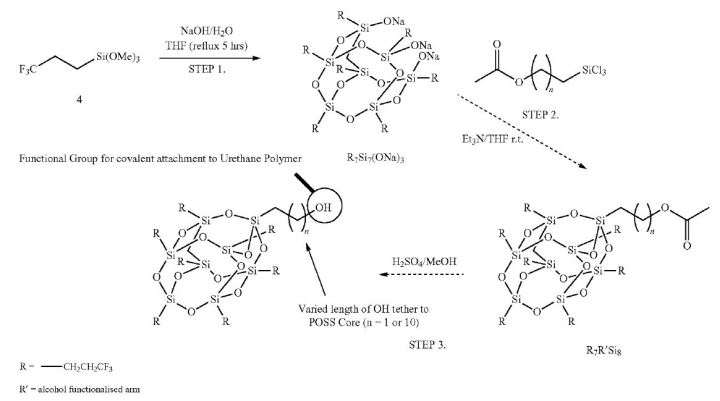
Synthesis of OH-functional trifluoropropyl POSS

PU-Acrylate/Epoxy IPN for 3D Printing

Patent Title: PHOTOCURABLE COMPOSITIONS FOR THREE-DIMENSIONAL PRINTING

 Number/Link:  WO 2016/153711

Applicant/Assignee: Dow

Publication date: 29-09-2016

Gist”: Acrylate-capped PU prepolymer is copolymerized with epoxides using UV radiation

Why it is interesting: This case is about UV-curable compositions to make flexible materials using additive manufacturing, especially stereolithography.  A prepolymer of an isocyanate and a ‘flexible’ polyol is capped with a hydroxy-functional acrylate, then mixed with a multifunctional epoxy, a multifunctional acrylate ‘monomer’ (a crosslinker also acting as reactive diluent) and two photoinitiators:  one radical and one cationic.  In the example a 6 to 8000 Mole weight diol is capped with TDI and then with hydroxyethyl acrylate.  The prepolymer is then mixed with 3,4-Epoxycyclohexylmethyl-3,4-epoxycyclohexane carboxylate, 1,6-hexanedioldiacrylate and two photoinitiators.  After UV curing the materials had a shore A hardness between about 60 and 80 and an elongation at break between about 70 and 200.

3,4-Epoxycyclohexylmethyl-3,4- epoxycyclohexane carboxylate

3,4-Epoxycyclohexylmethyl-3,4-
epoxycyclohexane carboxylate

Polyurethane Prepolymer with Very Low Monomeric Isocyanate Content

Patent Title: ULTRALOW MONOMER POLYURETHANES

 Number/Link: WO 2016/142513

Applicant/Assignee: Henkel

Publication date: 15-09-2016

Gist”: An NCO-ended prepolymer is reacted with a bis(alkoxysilylalkyl)amine

Why it is interesting: This invention is about laminating adhesives with a ‘primary aromatic amine migration limit’ of less than 10ppb, in accordance with the EU regulation for food packaging laminates. The low monomeric content is achieved by first making a NCO-ended prepolymer, which is then reacted with an monofunctional ‘H-acidic’ compound, preferably a bis(alkoxysilylalkyl)amine.  In an example a mixture of diols (OHv 108 to 236) was  reacted with 2.4-TDI down to an NCO value of 3.85%. Then 4,4′ MDI, trimethylolpropane and a triiso based on TDI were added to an NCO value of 2.2%.  Finally the prepolymer was reacted with bis(3-(triethoxysilyl)proplyl)amine at an NCO/NH ratio of 7:1.  Final NCO value was 2% with 0.05% (w/w) free 2,4-TDI and less than 0.01% free 4,4′-MDI. The prepolymer is said to be useful in 1K and 2K adhesive compositions and is said to have better adhesion properties and reactivity compared to NCO-free adhesives like sile silane-terminated PU adhesives.

Bis(3-(triethoxysilyl)propyl)amine

Bis(3-(triethoxysilyl)propyl)amine

  • Pages

  • Categories

  • Enter your email address to follow this blog and receive notifications of new posts by email.

    Join 259 other subscribers
  • Follow Innovation in PU on Twitter