Isocyanate-Free Polyaminal-Polyurethane Foams

Patent Title: SYSTEM FOR DIMENSIONALLY STABLE ISOCYANATE-FREE POLYURETHANE FOAM

 Number/Link: WO2018/005142

Applicant/Assignee:  Dow

Publication date: 4 January 2018

Gist”: Polyaldehydes are reacted with polycarbamates in the presence of an acid catalyst, a metal oxide powder and a blowing agent.

Why it is interesting: According to this invention hydrolytically-stable foams can be prepared from a low molecular weight difunctional aldehyde and a polycarbamate with a functionality of about 3.5 to 4 and an equivalent weight of about 200 to 300, in the presence of a blowing agent and a protic acid as catalyst. Surprisingly the foams are rendered hydrolytically stable by the incorporation of a metal oxide powder with a specific particle size. In the examples polycarbamates are prepared by capping high functionality polyols with methylcarbamate and are then reacted with 1,4-cyclohexanedicarbaldehyde together with p-toluensulfonic acid as catalyst, HFC245fa as blowing agent and MgO powder. The foams show densities of 130-170 kg/m³ and are said to be useful as sealants.

CHDA

Cyclohexanedicarbaldehyde

PCM-Containing Viscoelastic Foams

Patent Title: VISCOELASTIC POLYURETHANE FOAM WITH COATING

Number/Link: WO2017/210439

Applicant/Assignee: Dow

Publication date: 7 December 2017

“Gist”: Open-celled visco-foam is impregnated with an aqueous dispersant composition containing a phase change material

Why it is interesting: According to Dow, open-celled viscoelastic polyurethane foams can be prepared by using a acid-modified polyolefin latex cellopener, as discussed before in this blog. In the current invention these open-celled foams are impregnated with an aqueous composition comprising an ionomer (a sodium salt of a maleic anhydride copolymer) and a microencapsulated PCM. The composition is said to ‘coat’ the cell struts with PCM and increase the comfort properties of the foam.
I wonder if with this process enough PCM can be in introduced to have a noticeable effect.

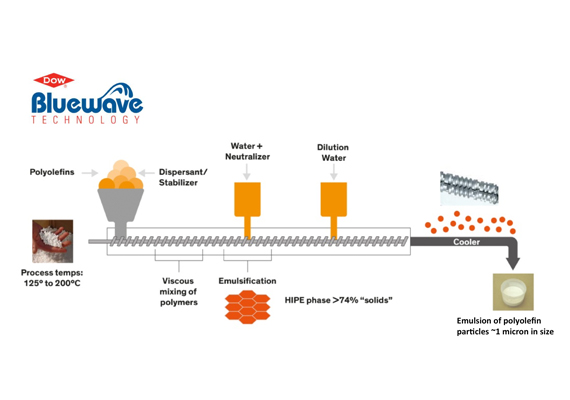
bluewave

Dow’s proprietary BLUEWAVE dispersion process is used to prepare the cellopening latex

Natural Oil Polyols using Self-Metathesis

Patent Title: POLYOLS FORMED FROM SELF-METATHESIZED NATURAL OILS AND THEIR USE IN MAKING POLYURETHANE FOAMS

 Number/Link: US2017/0291983

Applicant/Assignee:  Trent Univ.

Publication date: 12 october 2017

Gist”: NOPs from self-metathesized soy oils

Why it is interesting: The use of metathesis chemistry to modify natural oils before converting them to polyols has been discussed before in this blog:  see e.g. US2015/0337073, to the same applicant, which relates to cross-metathesis of natural oils using (e.g.) 1-butene. The current case is about self-metathesis of unsaturated natural oils, resulting in ‘metathesis oligomers’ which are then (partially) epoxidated and hydroxylated to prepare the polyols. In the examples soybean oil is turned into polyols with OH values between about 100 and 250, which are used to make flexible foams with densities of more than 150 kg/m³.

Oligomer from self-metathesis of unsaturated triglycerid


  • Pages

  • Categories

  • Enter your email address to follow this blog and receive notifications of new posts by email.

    Join 259 other subscribers
  • Follow Innovation in PU on Twitter