Polyurethanes from Bisphenol-Based Polyols

Patent Title:  OLIGOMERIC POLYOL COMPOSITIONS

 Number/Link:WO2018/190891

Applicant/Assignee:  Presidium USA

Publication date: 18 October 2018
Gist”: Polyurethanes from high functionality  bisphenol-based polyols

Why it is interesting: The invention relates to high functionality (and high viscosity) polyols that consist of bisphenol moieties and aliphatic polyol moieties and that can be prepared by reacting a bisphenol-based polycarbonate with a short-chain, high functionality polyol in the presence of a suitable catalyst or promotor.  In the examples a bisphenol-A based polycarbonate powder is reacted with propoxylated pentaerythritol and a tetra – OH – functional tert-amine that acts as a promotor.  The polyols are said to be useful for high stiffness polyurethanes that show improved heat distortion and a relatively low reaction exotherm.
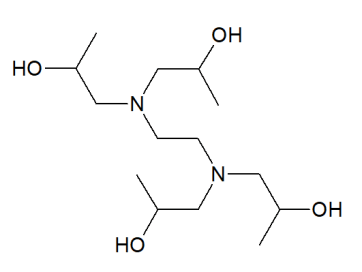
multranol

Catalytic tetrol used in the invention


Novel i-PEEP Polymers

Patent Title:  ISOCYANATE-MODIFIED POLYESTER-EPOXIDE POLYMER COMPOSITIONS

 Number/Link: WO2018/160217

Applicant/Assignee:  Stepan

Publication date: 7 September 2018

“Gist”: Polyester polyols are reacted with isocyanates and polyepoxies

Why it is interesting: The invention is related to isocyanate-modified polyester-epoxy polymers (i-PEEPs) which are said to be a “new class of polymers” useful as adhesives, coatings and elastomers.  The materials are prepared by reacting polyester polyols with both polyisocyanates and polyepoxies at an “i-PEEP index” (=(eqvs iso + eqvs epoxy)/eqvs polyol in %) of 100 to 200. The reaction can be run catalysed at room temperature or optionally un-catalyzed at 40 to 100°C. In the examples aromatic and aliphatic polyester polyols are reacted with polymeric MDI and BPA-DGE – based polyepoxide at different indices to produce elastomers with shore A hardness ranging between 30 and 95.
Interesting materials, although calling them a new class of polymers may be a bit exaggerated.

Bisphenol_A_diglycidyl_ether_200

Bisphenol-A diglycidylether (BPA-DGE)


Polyurethane Oil Gel

Patent Title: OIL GEL, PRESSURE RESISTANT MATERIAL USING SAME FOR PROTECTING ELECTRONIC DEVICES AND OIL GEL-FORMING AGENT

 Number/Link: WO2018135494  (Japanese)

Applicant/Assignee:  Sec Corp.

Publication date: 26 July 2018

Gist”: A gel from a paraffinic  oil and a compatible linear PU is used as a pressure resistant material for deep-sea applications

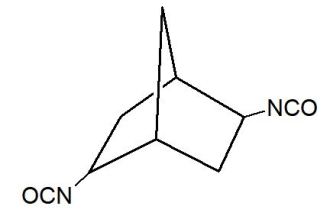
Why it is interesting: The invention relates to a PU-oil gel that is used as a kind of “potting compound” to protect subsea electronics at “abyssal depths” , i.e. at pressures of 5.6 MPa (about 550m deep). The gel is prepared by reacting a hydrophobic diol and a hydrophobic diisocyanate in the presence of 10-50% (w/w) on the total composition of a paraffinic oil. In the examples an OH-ended, saturated polyisoprene is used as diol together with norbornanediisocyanate.

NBDI

2,5-norbornane diisocyanate

  • Pages

  • Categories

  • Enter your email address to follow this blog and receive notifications of new posts by email.

    Join 259 other subscribers
  • Follow Innovation in PU on Twitter