Classic PU Patent of the Month: Polyurethane-Polyurea RIM Elastomers (Bayer 1976)

Title: VERFAHREN ZUR HERSTELLUNG VON ELASTISCHEN FORMKOERPERN

 Number/Link: DE262295 (German)

Applicant/Assignee: Bayer

Publication date: 24-11-1977

Gist”: Use of DETDA  in one shot PU-PUA RIM.

Why it is interesting: This is the invention that for the first time allowed the production of large reaction injection moulded (RIM) polyurea articles with a very short demould time. Apart from advances in mixing head design which allowed for fast and accurate mixing and advances in mould design, polyurea RIM was made possible by the development of specific diamine chain extenders.  Bayer found that aromatic diamines containing one alkyl group in o-postion to a first amino group and two alkyl groups in o-position to a second amine group, where at least two of the alkyl groups contain 2 or more carbon atoms, have the correct reactivity for a one shot RIM process when used together with conventional polyether polyols, MDI and catalysts. A preferred example of such a diamine is diethyltoluenediamine (DETDA). The use of DETDA in one shot RIM allowed for the production of  parts up to 10 kg with a demould time of 30 seconds.
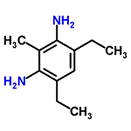
DETDA
DETDA

Classic PU Patent of the Month: ICI on MDI Prepolymers and “Cold Cure” Flexible Foams (1978)

Title: Liquid polyisocyanate compositions

 Number/Link:  EP10850

Applicant/Assignee: Imperial Chemical Industries

Publication date: 14-05-1980

Gist”: Liquid compositions from 2,4’/4,4′-MDI  prepolymers and polymeric MDI.

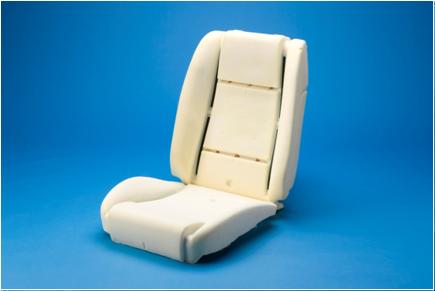
Why it is interesting: The first polyurethane flexible foams were all based on toluene diisocyanate (TDI).  Other commericially available isocyanates like “pure MDI”  (4,4’/ 2,4′- diphenylmethane diisocyanates mixtures) and “crude MDI” (mixtures of MDI and its higher homologues) were not suited for flexible foam production: the former because of it’s high crystallinity and therefore too high melting point and the latter because of its too high functionality.  This classic invention solved the problem by prepolymerizing  a 2,4’/4,4′-MDI mixture with a “flexible” polyol to an NCO content of 8 to 26% and then adding 10-50% of crude MDI to obtain a liquid composition. These liquid MDI compositions allowed the production of cold cure moulded flexible foams and the first MDI-based car seat cushions.

Cold cure moulded car seat cushions

Cold cure moulded car seat cushions

Classic PU Patent of the Month: Scott Paper Co. on Reticulated Polyurethane Foams (1964)

Title: Reticulated polyurethane foams and process for their production

 Number/Link: US3171820

Applicant/Assignee: Scott Paper Co.

Publication date: 2-03-1965

Gist”: PU foams are reticulated by hydrolysis or explosion.

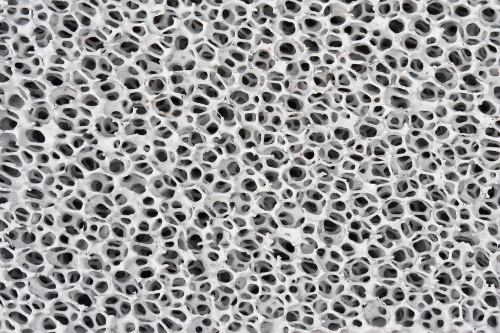
Why it is interesting:   Reticulated foams are foams from which the membranes have been removed so that only a three dimensional network of strands or ‘struts’ remains. These materials are commercially available in different grades of stiffness and porosity and are useful in applications such as filtering, sound absorbing, padding and the like. The current invention – filed in 1964 but a ‘continuation’ of an application filed in 1956- teaches the two processes to reticulate PU foam still in use today. The first process uses an aqueous NaOH solution to hydrolyse the cell membranes, in the second process a foam block is brought in an autoclave together with an explosive gas mixture (e.g. a mixture of oxigen and acetylene) which is then made to explode using a spark plug. When executed correctly the explosion removes all cell membranes leaving the struts intact. ‘Explosive recticulation’ is one of my all-time favorite PU inventions: simple, yet very effective and very courageous. In the current culture of hyper-safety where employees have to report paper-cuts, inventions like this are no longer possible.

Recticulate polyurethane foam

A recticulated polyurethane foam

  • Pages

  • Categories

  • Enter your email address to follow this blog and receive notifications of new posts by email.

    Join 259 other subscribers
  • Follow Innovation in PU on Twitter