Coated Fracking Proppants

Patent Title: AMIDE BASED COATING

 Number/Link: WO2017/213855

Applicant/Assignee:  Dow

Publication date: 14 December 2017

Gist”: Proppant particles are coated with polyamide based on isocyanate and carboxylic acids

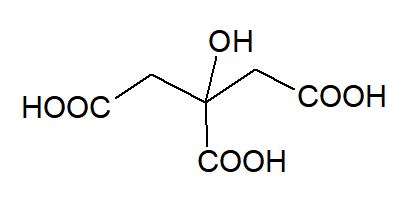
Why it is interesting: Proppant particles are used in the hydraulic fracturing process to force open rock fissures to extract gas and oil – as discussed before in this blog. According to this invention the proppant particles are coated with a reacting mixture of a polyisocyanate (e.g. polymeric MDI) and polycarboxilic acids (e.g. a blend of citric acid and an acid-terminated polyether triol). Under the high pressure and temperature of the fracture, the coating will bond the proppant particles together, thus preventing flow-back of the proppant and the blocking of the well. The coating can contain additives to capture heavy metals like radium and sulfides like hydrogensulfide to reduce contamination of the fracture fluid.
citricacid

Citric acid

Modified Polyisocyanurates

Patent Title: MODIFIED POLYISOCYANURA TE PLASTIC AND METHOD FOR PRODUCTION THEREOF

 Number/Link: WO2017/182108 WO2017/182109  WO2017/182110  (German)  

Applicant/Assignee:  Covestro

Publication date: 26-october-2017

Gist”: Partially trimerized diisocyanates are modified with monofunctional isocyanate-reactive compounds before complete trimerization

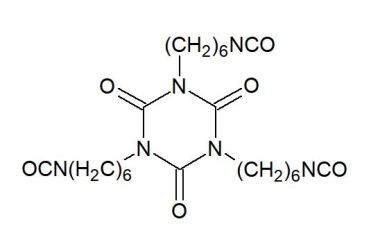
Why it is interesting: This series of applications relates to transparent polyisocyanurate coatings with controlled hydrophilicty, hydrophobicity, high scratch resitance etc. According to the invention trimers of diisocanates are reacted with a sub-stoichiometric amount of monofunctional hydrophobic, hydrophilic or siloxane-containing compounds, and then completely trimerized. In the examples HDI-trimer (prepared by partially trimerzing HDI and removing the rest of the monomer by thin film distillation) is reacted with e.g. methoxyPEG 500, dodecanol, perfluoroheptanol and N-(3-trimethoxyxilylpropyl)foramide and then trimerized using potassium acetate as catalyst.  The materials can e.g. be used as anti-fog coatings on optical lenses or anti-fingerprint coatings on cell phones.

HDI-isocyanurate

Breathable TPU Membranes

Patent Title: POROUS THERMOPLASTIC MEMBRANES

 Number/Link: WO2017/178482

Applicant/Assignee:  BASF

Publication date: 19-october-2017

Gist”: Semi-permeable membranes are made by phase inversion of all-hardblock TPU solutions

Why it is interesting: ‘Breathable” membranes show a high resistance to liquid water permeation (LEP) combined with a high water vapour permeability (WDD). According to this invention breathable polyurethane membranes can be prepared by dissolving an all-hardblock thermoplastic polyurethane in a polar, aprotic solvent (like N-methyl pyrrolidone) together with a water soluble compound, casting a film and coagulating the film with water. In the examples diisocyanates (MDI, TDI and HDI) are stoichiometrically reacted with chain extenders (MEG, BDO and HDO).  The resulting materials were schredded and dissolved in NMP together with some glycerol. 150 μm thick films were cast on glass and coagulated in water, resulting in membranes with an average pore size ranging between 4 and 500 nm.  The membranes are said to be useful to make breathable fabrics for outdoor wear e.g. (“Gore Tex” (TM) – type materials)

N-methyl-2-pyrrolidone


  • Pages

  • Categories

  • Enter your email address to follow this blog and receive notifications of new posts by email.

    Join 259 other subscribers
  • Follow Innovation in PU on Twitter