Using PU Foams as a Template for Silicone Foams

Title: FOAM-LIKE MATERIALS AND METHODS FOR PRODUCING SAME

 Number/Link:US2014/154491

Applicant/Assignee: Allergan

Publication date: 5-06-2014 (priority PCT/US)

Gist”: A polyurethane foam is impregnated with a curable liquid silicone.  After curing of the silicone the PU is removed.

Why it is interesting: According to this invention open celled polyurethane (or melamine) foam structures can be ‘converted’ into other materials like silicone, polyesters, polyolefins etc. by impregnating them with the the appropriate raw materials, curing and removing the ‘base’ foam. Optionally the ‘converted’ foam structure can be impregnated and cured again until the desired porosity is obtained.  In an example a PU foam was impregnated with a HTV silicone rubber.  After curing, the PU structure was removed using hydrogen peroxide.
While undoubtedly very interesting foam materials can be made in this way, the process seems messy and not very practical.

A 'base foam structure' (left has been impregnated and cured with another polymer (right).

A ‘base’ foam (left) and an impregnated foam (right) according to the invention.
 

Highly Stable Isocyanate Dispersions

Title: STORAGE-STABLE HYDROPHILIC POLYISOCYANATES

 Number/Link: WO2014/053269   (German)

Applicant/Assignee: Evonik

Publication date: 10-04-2014

Gist”: A uretdion-containing isocyanate prepolymer is reacted with a neutralized aminealkylsulfonic acid to produce a novel hydrophilic (latent) isocyanate which can be used in stable aqueous dispersions.

Why it is interesting: Aqueous dispersions of isocyanates are useful in many applications as adhesives, binders, crosslinkers etc, but usually suffer from a relatively short shelf life.  Dispersions prepared according to the current invention supposedly lose less than 30% of their initial NCO value after 12 weeks storage at 50°C. In an example an aceton-solution of  an IPDI-uretdion prepolymer with an isocyanate content of 1.5% is reacted with the sodium salt of an aminealkylsulfonate in water to an NCO value of 0.1%. After removal of the aceton the resulting dispersion had a latent isocyanate content of 4.5%

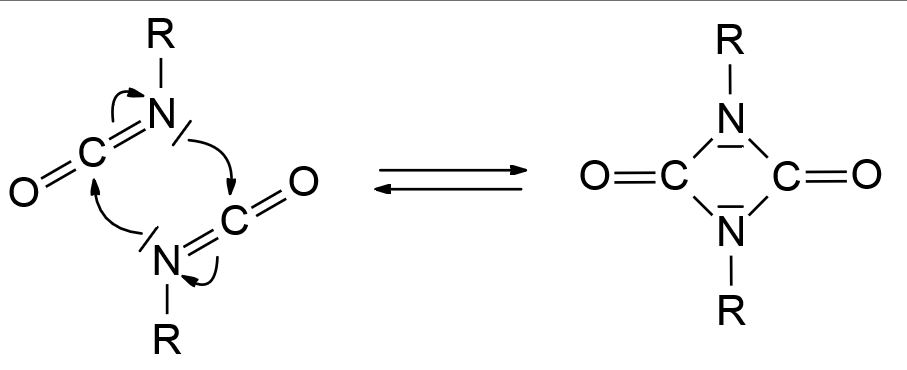
Dimerization of isocyanate to uretdion.

Reversible dimerization of isocyanate to uretdion.

Self-Cleaning Coating… or not?

Title: SELF-RENEWING HYDROPHILIC ORGANIC COATINGS

 Number/Link: US2014/018466

Applicant/Assignee: Empire Technology

Publication date: 16-01-2014

Gist”: Coating containing free amine groups resulting in a hydrophilic surface that is supposedly self-cleaning.

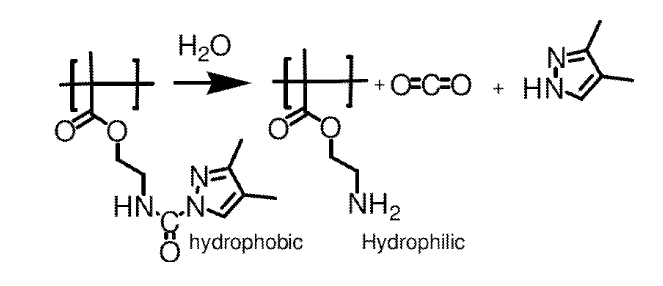
Why it is interesting: Conventionally “self-cleaning” surfaces are produced using hydrophobic coating compositions resulting in surfaces with low contact angles with respect to water.  The current case claims that highly hydrophilic surfaces also show a self-cleaning effect.  An emulsion-polymerized polymer with blocked-isocyanate side groups is used as a coating composition.  After the coating is applied the side groups are deblocked by atmospheric moisture resulting in (hydrophilic) amine groups.  In an example 2-methyl-acrylic acid 2-isocyanatoethyl ester blocked with 3,5-dimethylpyrazole was emulsion polymerized and, together with additives, used as a coating composition.
While this is fun chemistry I very much doubt that this coating would be truly self-cleaning.  The amine groups will surely react with all kinds of stuff in the air possibly resulting in quite the opposite.

deblocking of the isocyanate side groups under the influence of water.

deblocking of the isocyanate side groups under the influence of water.

  • Pages

  • Categories

  • Enter your email address to follow this blog and receive notifications of new posts by email.

    Join 259 other subscribers
  • Follow Innovation in PU on Twitter