Classic PU Patent of the Month: The First “HYPOL” Foams (1974).

Title: Dental and biomedical foams and method

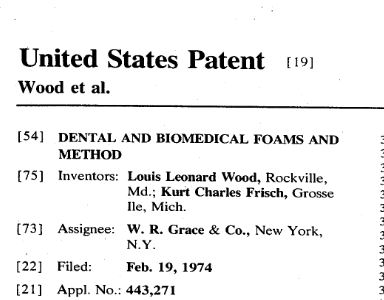
 Number/Link: US3903232

Applicant/Assignee: W.R.Grace

Publication date: 2-09-1975

Gist”: A branched, low NCO prepolymer made from all-EO polyol and TDI or pMDI is reacted with a large surplus of water to make a new class of flexible foams.

Why it is interesting: HYPOL™-type foams are very soft, highly hydrophilic flexible foams which can be produced catalyst-free from a high EO prepolymer and a high surplus of water. Originally the prepolymers were based on all-EO triols or tetrols and TDI 80/20, or -alternatively-  PEGs and polymeric MDI. Later these systems were further improved by myself in 1991 using 75% EO triols and 4,4′ MDI. The (after drying) low- to medium density foams are very robust and versatile, can be compressed and restored by adding water, and the specific production process allows to add all kinds of functionalities via the water stream. The HYPOL trademark is currently owned by Dow Chemicals and may encompass a wider range of materials than original.
US3,903,232
US3,903,232

Improved P.I.P. Foams

Title: Foam Composition and its Uses Thereof

 Number/Link: US2014/079940

Applicant/Assignee: MAS RES AND INNOVATION PVT

Publication date: 20-03-2014 (priority PCT)

Gist”: Use of 4 catalysts:  2 ‘normal’ and 2 ‘delayed action’ are used to formulate pour-in-place foams that resist fabric penetration.

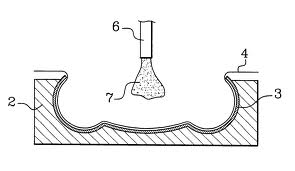
Why it is interesting: “Pour in place” or “in situ” foaming is a technique where a flexible foam-forming mixture is poured directly onto fabric to (typically) produce car seats. The fabrics used are often laminated with a thermoplastic film or a layer of polyester PU foam to prevent penetration of the foaming mixtures.  These liners however impair breathability and therefore comfort. The current invention should allow use of liner-free fabrics without strike through. Four different catalysts are used:  a normal gelling catalyst, a normal blowing catalyst a delayed action gelling catalyst and a delayed action blowing catalyst. The delayed action catalysts are conventional amine catalysts reacted with a suitable acid like lactic acid and become active at a temperature of around 50°C. When poured on a fabric-lined and heated mould, a flexible foam mixture formulated with these catalysts should gel imediately and not penetrate the fabric.

Pour-in-place technique:  2: mould, 3 fabric, 7 foam forming mixture.

Pour-in-place technique: 2: mould, 3 fabric, 7 foam forming mixture.

PIPA Polyol Made From “Conventional” Polyol

Title: PROCESS FOR THE PREPARATION OF A POLYOL COMPOSITION

 Number/Link: WO2014/037558

Applicant/Assignee: SHELL

Publication date: 13-03-2014

Gist”: A PIPA polyol is made from TDI,  TELA and a high sec-OH polyol which is added in two stages.

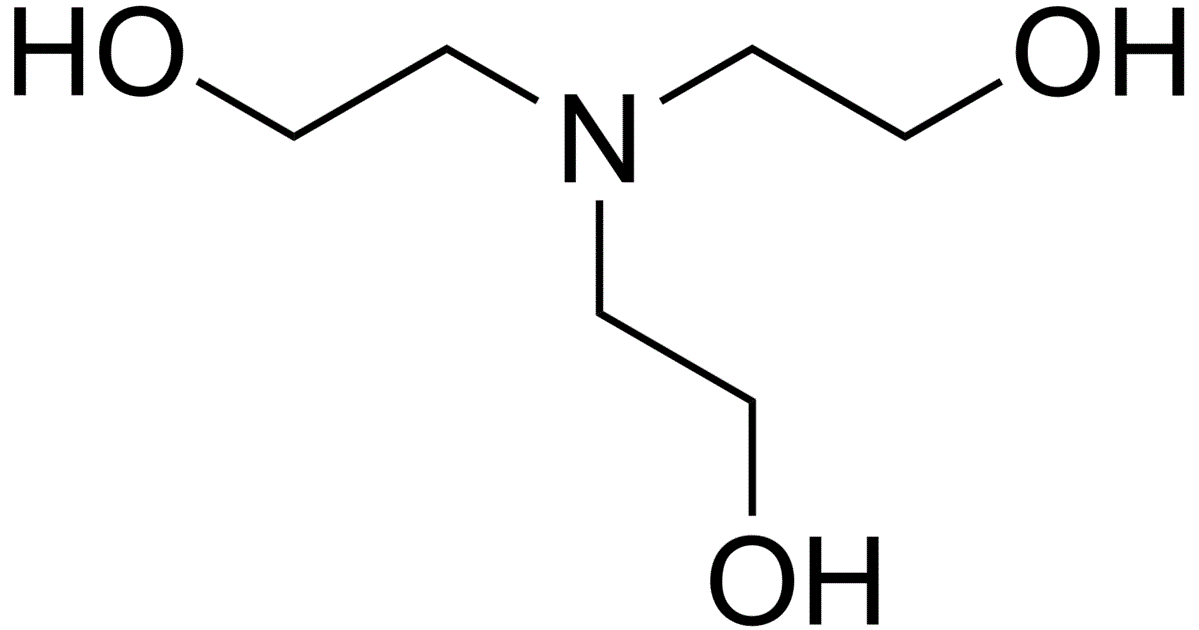
Why it is interesting: PIPA polyols are a class of ‘filled’ polyols containing dispersed polyurethane particles and are often used in flexible foams to improve hardness and air flow. These polyols are usually produced by dispersing an olamine, like triethanolamine (TELA), in an EO-tipped EO/PO polyether polyol and reacting it with isocyanate under mixing.  Producing PIPA polyols from a high secondary-OH containing (“conventional”) polyol, i.e. an all- PO or EO/PO random polyol would have cost advantages but -according to SHELL- results in an unstable polyol which produces closed-celled flexible foam. The trick they invented to solve this problem is to produce the particle dispersion from TELA and TDI in about 50% of the total amount of polyol used and adding the remainder of the polyol in a second step.  Remarkably this simple trick appears to be new and patentable.

Triethanolamine

Triethanolamine

  • Pages

  • Categories

  • Enter your email address to follow this blog and receive notifications of new posts by email.

    Join 259 other subscribers