Reducing Aldehyde Emissions from Polyurethane Foams

Title: USE OF PENTAETHYLENE HEXAMINE IN THE PRODUCTION OF POLYURETHANE SYSTEMS

 Number/Link: WO2015/071065 (German)

Applicant/Assignee: Evonik

Publication date: 21-05-2015

Gist”: Use of pentaethylenehexamine to reduce aldehyde emissions

Why it is interesting: As mentioned in previous posts, the reduction of formaldehyde and acetaldehyde emissions from polyurethane foams remains a pressing environmental issue. According to this patent application the problem can be solved by adding some (1 pphp in the examples) of pentaethylene hexamine to the polyol formulation. The polyamine will act as a formaldehyde scavenger and has some advantages over the prior art.  In the related case WO2015/071063, the pentaethylene hexamine is first reacted with guanidine chloride before being added to the formulation.

Pentaethylene hexamine
Pentaethylene hexamine

Self-Healing Polyurethanes

Title: SELF-HEALING POLYURETHANES

 Number/Link: WO2015/067833 (Spanish)

Applicant/Assignee: Fundacion Gaiker

Publication date: 14-05-2015

Gist”: Self-healing polyurethanes coatings can be prepared using dihydroxy coumarin derivatives

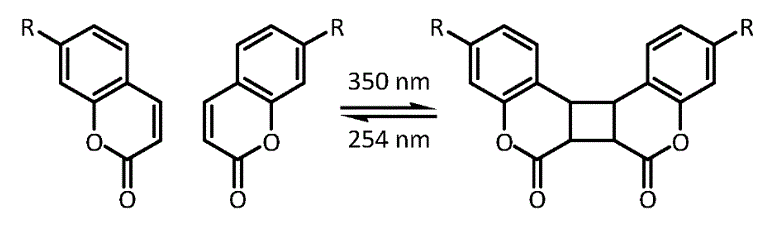
Why it is interesting: Self-healing polymers have been made before using e.g. microencapsulated ‘healing agents’ or supramolecular chemistry such as hydrogen-bond formation.  This patent application relates to polyurethanes having photochemical self-healing properties, which, in contrast to previous systems, have the advantage of allowing for multiple recoveries and for (potentially) being transparent. The self-repairing PU systems are based on the photodimerization and photocleavage reactions of coumarine-derivatives as shown in the scheme below.  Dihydroxy derivatives of coumarine can be built into PU coatings sytems. Damaged coatings can then be radiated with light of a wavelength of (pref.) 254nm to cleave coumarin dimers present, followed by radiation of about 340nm to (re-)form the dimers and repair the coating.

Photodimerization and -cleavage of coumarine derivatives

Photodimerization and -cleavage of coumarine derivatives

Syntactic Polyurethane Elastomers

Title: SYNTACTIC POLYURETHANE ELASTOMERS FOR USE IN SUBSEA PIPELINE INSULATION

 Number/Link: WO2015065769 WO2015065770 WO2015065771 WO2015065772

Applicant/Assignee: Dow

Publication date: 7-05-2015

Gist”: Zn/Zr catalyzed syntactic elastomers for subsea pipeline insulation

Why it is interesting: Conventional polyurethane rigid foams cannot be used for the insulation of subsea pipelines because the foams would collapse under the pressure and they are too brittle to be bent.  For these reasons syntactic elastomers can be a better choice for this application. Syntactic polyurethane elastomers consist of a solid PU matrix containing up to 50% (wt/wt) of hollow glass microspheres. The catalyst of choice to produce these materials is phenylmercury neodecanoate.  However because of regulatory pressure other catalyst systems are now being used.  The gist of these four patent applications appears to be the use of a mixture of a zinc carboxylate with a small amount of zirconium carboxylate as a replacement for the organomercury catalyst, but this is not the main claim (probably because of non-patentability). Instead the WO..69 case is about the use of polymer polyols in these systems,  the WO..70 case is about the use of low unsat polyols, WO..71 is about a special type of morphology and WO..72 about the use of prepolymers.

Phenylmercury neodecanoate

Phenylmercury neodecanoate

  • Pages

  • Categories

  • Enter your email address to follow this blog and receive notifications of new posts by email.

    Join 259 other subscribers