Sulfur Containing Polyurethane Elastomers for Tires and “Tweels”

Title: Polyurethane

 Number/Link: US2013/0287982

Applicant/Assignee: Michelin

Publication date: 31-10-2013  (priority PCT/FR)

Gist”: Use of dithiodiols or dithiodiamines in polyurethane elastomer formulations for improved adhesion to metal.

Why it is interesting: The current invention relates to polyurethane elastomers containing a chain extender mixture consisting of a conventional chain extender (e.g. butandiol) and 1-30% (of the total chain extender) of an S-S bridge containing diol or diamine like 2,2′-dithiodiethanol or 4,4′-dithiodianiline. The resulting polyurethane reportedly shows an increased bonding strength  to metal, which can be even more enhanced by adding elemental sulfur and conventional sulfur-containing rubber-curing accelerators like dithiocarbamates, thiurams, thiazoles etc. (as well known in the art of rubber vulcanization). The resulting polyurethanes are useful for the production of metal strand-reinforced composites like tires and ‘tweels’ (tweel=tire+wheel  see http://michelintweel.com/index.html).

Michelin "tweel"

Michelin “tweel”

Polyurethane Elastomers with High Abrasion Resistance

Title: POLYURETHANE WITH IMPROVED ABRASION RESISTANCE, THE METHOD FOR PREPARING THE SAME AND USE THEREOF

 Number/Link: US2013/0274365

Applicant/Assignee: Bayer

Publication date: 17-10-2013 (priority PCT/DE)

Gist”: Small amounts of polyisoprene improve abrasion resistance of elastomers

Why it is interesting: It is known that polyether polyols have advantages over polyester polyols for the production of polyurethane elastomers: the resulting elastomers have better low temperature properties, better hydroslysis resistance and antimicrobial properties, however the mechanical properties as well as the abrasion resistance are lower. According to this invention the abrasion resistance of polyether elastomers can be greatly improved by incorporating a small amount of polyisoprene in the formulation. In the examples 2% polyisoprene with a MW of 28,000 or 45,000 is used in a formulation of polyether polyol, butanediol, water and catalyst together with a non-disclosed isocyanate. The resulting elastomers have a density of 600 kg/m3 and show a markedly improved abrasion resistance.

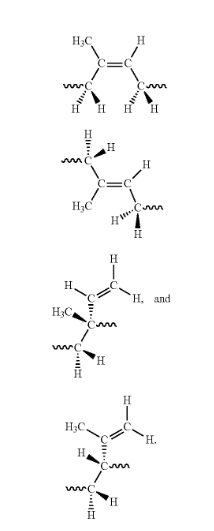
Structural units present in polyisoprene

Structural units present in polyisoprene

POLYURETHANE WITH IMPROVED ABRASION RESISTANCE, THE METHOD FOR PREPARING THE SAME AND USE THEREOF

Over-Indexed and Crosslinkable Thermoplastic Polyurethane

Title: METHOD FOR MAKING OVER-INDEXED THERMOPLASTIC POLYURETHANE ELASTOMER PRECURSOR AND THERMOPLASTIC POLYURETHANE ELASTOMER MADE FROM THE PRECURSOR

 Patent Number & Link: WO2013/103633

Applicant/Assignee: Nike

Publication date: 11-07-2013

Gist”: A TPU is produced at an NCO index of about 110 comprising an unsaturated chain extender .  The material can be injection moulded and subsequently cured with moisture and free radical polymerization.

Why it is interesting: A thermoplastic PU ‘precursor’ is prepared by reactive extrusion of  a polyol (e.g. a 2000MW polytetramethylene ether glycol), an unsaturated chain extender (e.g. trimethylolpropane monoallyl ether – TMPME), optional additives and MDI at an NCO index of 110 to 115 (preferred). After drying, the resulting pellets can be injection- or compression moulded and then cured by moisture and by heat or UV radiation. The resulting PU-polyurea is claimed to have improved toughness, durability and ‘scuff resistance’ compared to conventional TPUs.  The material appears to have been developed for the golf ball industry.  Nike has filed at least two related ‘golf ball patents’: WO2013/103673 and WO2013/103669.

TMPME: unsaturated chain extender used in the invention

TMPME: unsaturated chain extender used in the invention

  • Pages

  • Categories

  • Enter your email address to follow this blog and receive notifications of new posts by email.

    Join 259 other subscribers
  • Follow Innovation in PU on Twitter