PU Rigid Foams from Biomass Proteins

Title: POLYOLS FROM BIOMASS AND POLYMERIC PRODUCTS PRODUCED THEREFROM

 Number/Link:WO2015/105542

Applicant/Assignee:  Inventors

Publication date: 16-07-2015

Gist”: Soy bean proteins are hydrolysed and reacted with diamines and cylocarbonates to produce “rigid” polyols.

Why it is interesting: During recent years a lot of research has been done on the use of renewable raw materials in polyurethanes.  Most of this research was on the use of natural oils despite the fact that the availability of biomass proteins is much higher. Soybeans for example contain about twice as much protein (about 38% w/w) than oil (18%) and the price is about half that of the oil. According to this invention soybean proteins are hydrolysed into amino acids which are then reacted with ethylene diamine to make amine-ended monomers.  These monomers are reacted with a cyclocarbonate (ethylene carbonate or glycerol carbonate) resulting in a mixture of hydroxyurethane oligomers. The mixture is a low viscous liquid with high hydroxyl value useful for the production of rigid foams.
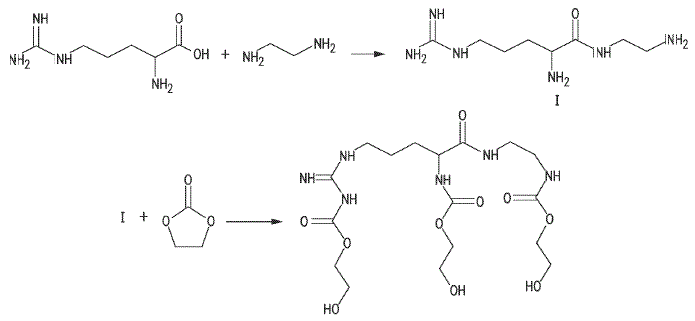
Reaction sequence according to the invention

Reaction sequence according to the invention

Classic PU Patent of the Month: ICI on Non-Isocyanate Polyurethanes (1961)

Title: Polyurethanes

 Number/Link: GB944310

Applicant/Assignee: Imperial Chemical Industries

Publication date: 11-12-1963

Gist”: Non-isocyanate polyurethanes by transurethanization of bis-carbamates and polyols.

Why it is interesting: Because of the growing concern over isocyanate toxicity and related changes in legislation, research and development of non-isocyanate polyurethane (NIPU) systems has increased sharply over the last few years. The idea, and most of the chemistry of NIPU is by no means new. In this patent, filed by ICI in 1961, NIPU is prepared by transesterification of bis-carbamates and polyols with a functionality of 2 or more. The materials are said to be especially useful for coatings and as TPU for fiber production. According to the patent, the advantages of this reaction system over the use of isocyanates are the reduction of the toxicity hazard, less moisture sensitivity and no need to carefully control reaction conditions and reactant proportions.  In an example N,N’-methylene-bis-urethane was reacted with 1,4-butanediol catalyzed by DBTDL resulting in a TPU which could be melt-drawn into fibers.  (Note that, in this case, ‘urethane’ is the common name for ethylcarbamate).

ICI logo anno 1961.

ICI logo anno 1961

Isocyanate-Free Polyurethanes Using Azide-Alkyne Click Chemistry

Title: SYNTHESIS OF POLYURETHANE POLYMERS VIA COPPER AZIDE-ALKYNE CLICK CHEMISTRY FOR COATINGS, ADHESIVES, SEALANTS AND ELASTOMER APPLICATIONS

 Number/Link: WO2014/122153

Applicant/Assignee: Sika

Publication date: 14-08-2014

Gist”: Polyurethane prepolymers capped with azides and alkynes are reacted using copper catalysis.

Why it is interesting: Because of safety, health and envriromental issues, isocyanate-free systems have clearly been gaining in importance the last few years.  Especially for coatings, adhesives and OCF applications, alternative curings systems are being developed. In the current invention an isocyanate-free system is based on the reaction between a prepolymer having at least two azide groups and a prepolymer having at least two alkyne groups. The reaction is copper catalyzed such that it can be performed at ambient temperature. The first prepolymer is (pref.)  prepared by reacting an isocyanate ended prepolymer with glycidol (2,3-epoxy-1-propanol) and subsequently with sodium azide. The second prepolymer is similarly prepared by reacting an isocyanate ended prepolymer with propargyl alcohol (2-propyn-1-ol).  The systems are said to be especially useful for roof coatings.

Example of an azide-alkyne reaction resulting in 1,4-disubstituded triazoles.

Example of an azide-alkyne reaction resulting in 1,4-disubstituded triazoles.


  • Pages

  • Categories

  • Enter your email address to follow this blog and receive notifications of new posts by email.

    Join 259 other subscribers
  • Follow Innovation in PU on Twitter