Polyurethane-Acrylate Plastisol

Patent Title: ACRYLIC-URETHANE IPN PLASTISOL

 Number/Link: US2016/0152857

Applicant/Assignee: Polyone

Publication date: 2-06-2016

Gist”: Plastisols from blocked-iso grafted acrylate in plasticizer

Why it is interesting:
Conventional plastisols are suspensions of PVC particles in a (usuallly phthalate-) plasticizer. The suspension can be cured by heating, which results in a plasticized elastomer.  Plastisols are used for coatings of e.g. car underbodies and for ‘screen printing’ of textiles. According to this invention a non-PVC plastisol can be produced by dispersing core-shell acrylate polymer particles (Mn between 300,000 and 1,000,000) with blocked isocyanate groups grafted to the backbone into a plasticizer, preferably into dioctylphthalate, together with a latent amine crosslinker like adipic dihydrazide. No information is given about the blocking agent but the plastisol is said to cure at 130-170°C and be especially suited for textile printing.

Adipic dihydrazide
Adipic dihydrazide

Polyurethane-Epoxy IPN Composites

Patent Title: POLYMER COMPOSITE THERMAL INTERFACE MATERIAL WITH HIGH THERMAL CONDUCTIVITY

 Number/Link: WO2016/079627

Applicant/Assignee: IBM

Publication date: 26-05-2016

Gist”: PU-Epoxy IPN particle composites show improved thermal conductivity

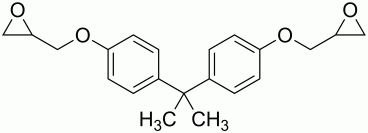
Why it is interesting: The application is about thermally conductive adhesives for use with electronic components. Commonly these materials consist of polymers filled with thermally- (but not electrically-) conductive particles such as AlN, BN and ZnO. According to the invention the thermal conductivity of these composites can be improved by using a polyurethane-epoxy true interpenetrating polymer network (IPN) as the matrix. In the examples a MDI-polycaprolactone prepolymer is mixed with a BPA diglycidylether prepolymer and boron nitride (BN) particles and crosslinked using trimethylolpropane and imidazole.  The thermal conductivity of the composite shows a synergy, meaning that it is clearly higher than the conductivities of both the PU or EP composites. The synergy is said to be due to an enhanced distribution of the BN particles and (because this is IBM and they are very clever) due to enhanced phonon scattering.

Bisphenol-A diglycidylether

Bisphenol-A diglycidylether

Dual-Cure PU for 3D Printing

Patent Title: POLYURETHANE RESINS HAVING MULTIPLE MECHANISMS OF HARDENING FOR USE IN PRODUCING THREE-DIMENSIONAL OBJECTS

 Number/Link: US2016137839

Applicant/Assignee: Carbon3D

Publication date: 19-05-2016

Gist”: Isocyanates are blocked with ethylenically unsaturated blocking agents

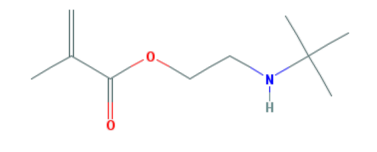
Why it is interesting: This invention relates to additive manufacturing of 3D objects using photocurable liquids. The liquid consists of a diisocyanate, or a difunctional isocyanate-ended prepolymer, which is blocked with an ethylenically unsaturated blocking agent, for example t-butylaminoethylmethacrylate (TBAEMA). The photocurable liquid further comprises a diol (or diamine), a photoinitiator and a ethylenically unsaturated diluent, for example a methacrylate or a styrene.  The liquid can then be selectively cured into an intermediate solid 3D object by irradiation with UV light using conventional “printing” methods. After an optional washing stage the intermediate object can be finally cured using heat.

TBAEMA

TBAEMA

  • Pages

  • Categories

  • Enter your email address to follow this blog and receive notifications of new posts by email.

    Join 259 other subscribers
  • Follow Innovation in PU on Twitter