Improved Viscoelastic Flexible Foams (“Memory Foams”)

Title: USE OF POLY(BUTYLENE OXIDE) POLYOL TO IMPROVE DURABILITY OF MDI-POLYURETHANE FOAMS

Patent Number & Link:  US2013178548    (related case US2013178550 )   

Applicant/Assignee: Dow

Publication date: 11-07-2013 (priority PCT/US)

Gist”: Use of a high molecular weight butyleneoxide monol to improve the compression set of viscoelastic foams.

Why it is interesting: Viscoelastic or “memory” flexible foams are currently popular for use in matresses and pillows. Much research and development has been done on these materials and the patent situation is a true minefield. Usually a mixture of EO-rich and PO-rich polyols of different molecular weights is used to control the glass transition temperature (Tg) of the softblock, wich in turn controls the energy absorption (and thus the resilience) of the foam. In this invention a butyleneoxide monol of high MW is used in addition to a mixture of EO-rich and PO-rich polyols. The BO-monol is used in an amount of 2-10% on the polyol  and supposedly improves compression set while retaining the open cell character (air flow) of the foam.
The related case (US2013/178550) is similar but uses a high MW PO polyol with a functionality between 1 and 4 instead of the BO monol.  It is not immediately clear to me whether this latter case is a real invention or is just plugging a hole in the minefield..

A viscoelastic flexible foam
A viscoelastic flexible foam

Viscoelastic Polyurethane Foam with Porous Struts

Title: CELLULAR STRUCTURES AND VISCOELASTIC POLYURETHANE FOAMS

 Number/Link: US2013035413

Applicant/Assignee: DOW GLOBAL TECHNOLOGIES

Publication date: 7-02-2013

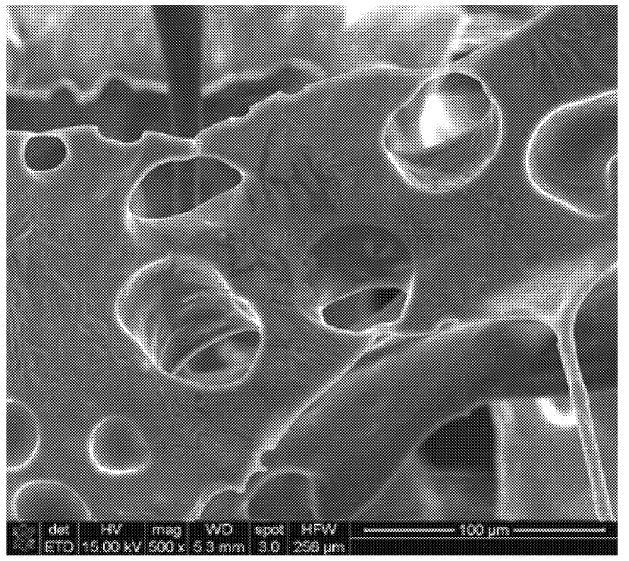
Gist”: The use of high equivalent weight polybutylenoxide monol together with a polyol mixture and TDI to produce a viscoelastic  foam with greatly improved airflow.

Why it is interesting: Most viscoelastic (or “memory”) foams are used in bedding and often have the disadvantage of building up heat and moisture during use, resulting in the loss of viscoelastic properties and deterioration in comfort. Improving the airflow through the foam should reduce this effect. Dow now appears to have cracked the airflow problem by using  a polybutylene oxide monol (preferred) with and eq.wt. of about 4000, together with a conventional blend of high EO and high PO polyols and TDI80 (in the examples).  Air flow indeed seems to be greatly improved and even the cell struts appear to be perforated!  Great stuff.

Foams cells showing porous struts

Foams cells showing porous struts

Polyurethane Elastomers with Very Low Glass Transition Temperature

Title: Low temperature segmented copolymer compositions and methods

 Number/Link: US8334356

Applicant/Assignee: Boeing

Publication date: 18-12-2012

Gist”: Polyurethane/polyurea elastomer based on a softblock mixture comprising dihydroxyalkyl terminated polydimethylsiloxane and a hydroxy terminated perfluoroether (or other low Tg softblock like OH terminated polybutadiene, polyphosphazenes etc) together with a rigid diamine chain extender (DETDA type) and a diisocyanate (HMDI in the examples). The softblocks have a molecular weight of 5000 or more and a functionality of 2.

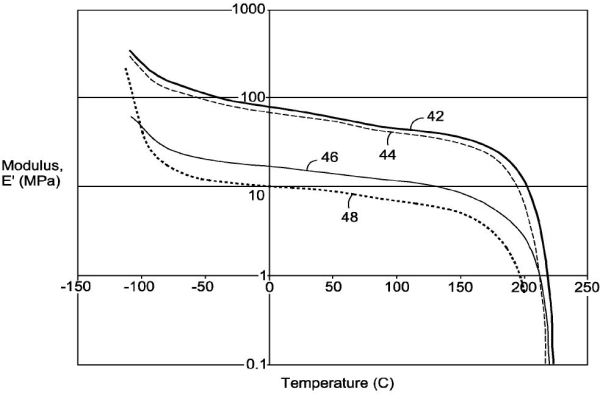
Why it is interesting:  The materials are claimed to have a Tg between -60 and -110°C with still very high elongation and tensile strength values at -100°C. The molecules are linear but will probably not melt because of the high urea content.  They will however be soluble in the correct solvents.

Tgs

Modulus-Temperature graphs of materials according to the invention.

  • Pages

  • Categories

  • Enter your email address to follow this blog and receive notifications of new posts by email.

    Join 259 other subscribers
  • Follow Innovation in PU on Twitter