Flexible Foams with Improved Thermal Comfort

Title: IN-SITU GELATINOUS TRIBLOCK COPOLYMER ELASTOMERS IN POLYURETHANE FLEXIBLE FOAMS

 Number/Link:US2015/0166756

Applicant/Assignee: Peterson Chemical Technology

Publication date: 18-06-2015

Gist”: Gelatinous styrenic block copolymers are incorporated in flexible foams to increase thermal conductivity.

Why it is interesting: High viscosity styrenic triblock copolymer resins (like SBS, SEBS, SIS etc), plasticized with mineral oils, are added to flexible foam-forming compositions. The heat of the foam-forming reaction is said to be sufficient to further polymerize the resins and melt the styrene-block such that the block copolymers get integrated into the polyurethane matrix. The resulting foams show increased load bearing and improved thermal conductivity. These systems could improve the thermal comfort properties of cushioning materials, especially those of viscoelastic foams.

Poly(styrene-butadiene-styrene) or SBS.

Poly(styrene-butadiene-styrene) or SBS.

Polyurethanes with Reduced Aldehyde Emissions

Title: POLYURETHANES HAVING REDUCED ALDEHYDE EMISSION

 Number/Link:WO2015/082316 (German)

Applicant/Assignee: BASF

Publication date: 11-06-2015

Gist”: Use of CH-acidic compounds as aldehyde scavengers

Why it is interesting: Reducing VOC emissions, and especially aldehyde emissions, from polyurethane systems remains an important research topic and has been discussed before on this blog (see e.g.  here and here). To reduce aldehyde emissions, scavenger molecules are used which are often amines or hydrazine compounds.  In this invention however the aldehyde scavenger is a CH-acidic compound of the form R-CH2-R’ in which R and R’ are electron-withdrawing groups. The R-groups can be iso-reactive and the molecule can (preferably) contain more than one acidic CH2 group, like e.g. trimethylolpropane triacetoacetate. Other examples are N,N-dimethylacetoacetamide and dimethyl 1,3-acetonedicarboxylate. The compounds are used in an amount of 0.5 to 1 pphp, are said to have advantages over the prior art like less or no catalytic activity and do not lead to extra emissions.

Trimethylolpropane triacetoacetate

Trimethylolpropane triacetoacetate

Self-Healing Polyurethanes

Title: SELF-HEALING POLYURETHANES

 Number/Link: WO2015/067833 (Spanish)

Applicant/Assignee: Fundacion Gaiker

Publication date: 14-05-2015

Gist”: Self-healing polyurethanes coatings can be prepared using dihydroxy coumarin derivatives

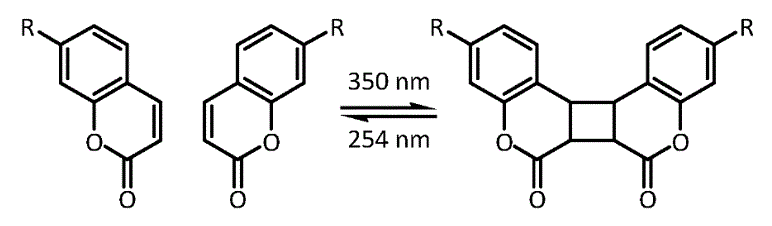
Why it is interesting: Self-healing polymers have been made before using e.g. microencapsulated ‘healing agents’ or supramolecular chemistry such as hydrogen-bond formation.  This patent application relates to polyurethanes having photochemical self-healing properties, which, in contrast to previous systems, have the advantage of allowing for multiple recoveries and for (potentially) being transparent. The self-repairing PU systems are based on the photodimerization and photocleavage reactions of coumarine-derivatives as shown in the scheme below.  Dihydroxy derivatives of coumarine can be built into PU coatings sytems. Damaged coatings can then be radiated with light of a wavelength of (pref.) 254nm to cleave coumarin dimers present, followed by radiation of about 340nm to (re-)form the dimers and repair the coating.

Photodimerization and -cleavage of coumarine derivatives

Photodimerization and -cleavage of coumarine derivatives

  • Pages

  • Categories

  • Enter your email address to follow this blog and receive notifications of new posts by email.

    Join 259 other subscribers
  • Follow Innovation in PU on Twitter