Hybrid Polyurethane-Peptide Dispersion

Patent Title: AQUEOUS PEPTIDE-STABILIZED POLYURETHANE DISPERSIONS

 Number/Link: W02016058909

Applicant/Assignee: Henkel; Max Planck Ges.

Publication date: 21-04-2016

Gist”: An NCO-ended prepolymer is reacted with a peptide mixture in water at correct pH

Why it is interesting: According to this invention a low-VOC, surfactant- free, stable dispersion can be prepared by reacting an isocyanate-ended preopolymer with an aqueous solution of peptides. The prepolymer is prepared from a polyether-, polyester- or PDMS diol and a surplus of (preferably) aliphatic isocyanate. The peptide mixture is obtained by hydrolysis or enzymatic cleaving of naturally occuring proteins and is dispersed in water at a pH well above the highest isoelectric point present in the mixture. This will ensure reaction of the isocyanate with the peptides instead of water.
Polymer-protein hybrids are interesting because they allow for unique properties not attainable with synthetic polymers alone, such as a selective and specific interaction with other biomolecules and a controlled response to external stimuli like pH and temperature.

Example of a tetrapeptide: Val-Gly-Ser-Ala. (Wikipedia)

Example of a tetrapeptide: Val-Gly-Ser-Ala. (Wikipedia)


Dianhydrohexitol-Based TPU

Patent Title: METHOD FOR PREPARING THERMOPLASTIC POLYURETHANE PELLET

 Number/Link:  WO2016/055731  (French)

Applicant/Assignee: Roquette Freres

Publication date: 14-04-2016

Gist”: Use of isosorbide as chain extender for TPU preparation

Why it is interesting: According to this invention the use of dianhydrohexitols as chain extender results in thermoplastic polyurethanes with improved overmoulding properties, notably improved colour, abrasion resistance and soft touch. In the examples TPUs prepared from 4,4’MDI, PTMEG 1000 and chain extended with isosorbide are compared to 1,4-butanediol extended TPUs. The isosorbide TPUs are softer with better abrasion resistance and -in my opinion surprisingly- have a somewhat brighter colour.

Isosorbide

Isosorbide


TPU from HDI and H12MDI

Patent Title: NON-SOFTENING RESILIENT THERMOPLASTIC POLYURETHANES

 Number/Link: WO2016/054320

Applicant/Assignee: Lubrizol

Publication date: 7-04-1016

Gist”: TPU from a blend of HDI and H12MDI has improved creep and wet modulus

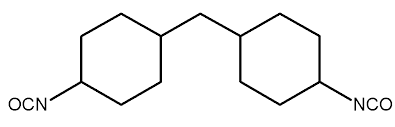
Why it is interesting: Polymeric materials used for in vivo medical applications like catheters, need to be hydrolytically stable and retain physical properties like stiffness, resilience, flexibility etc. in wet conditions.  It is known that conventional TPUs based on aromatic or cyclo-aliphatic isocyanates tend to show some softening in aqueous environments. For this reason copolyamides (COPAs) and polyether-block-polyamides (PEBAs) are often preferred over TPU for use in medical devices.  According to this invention, TPUs that can replace COPA and PEBA in medical applications can be produced using a blend of 1,6-hexanediisocyanate (HDA) and H12MDI. In the examples polyether TPUs, prepared from 2000MW polytetramethyleneether diol, butanediol and a 19:1 HDI:H12MDI isocyanate blend at harblock contents ranging from 15 to 50%, convincingly show improved creep properties and wet modulus when compared to conventional TPU and a commercial PEBA material.

H12MDI

H12MDI

  • Pages

  • Categories

  • Enter your email address to follow this blog and receive notifications of new posts by email.

    Join 259 other subscribers
  • Follow Innovation in PU on Twitter