Thermoplastic Polyurethanes from Polyesters Based on “Bio”-Propanediol.

Title: THERMOPLASTIC POLYURETHANE WITH REDUCED TENDENCY TO BLOOM FROM A BIO-BASED GLYCOL

 Number/Link: WO2012173911

Applicant/Assignee: Lubrizol

Publication date: 20-12-2012

Gist”: TPUs with less tendency to “bloom” are prepared from diisocyanate, diol chain extender and a polyester polyol based on 1,3-propanediol and adipic acid.

Why it is interesting:  “Blooming” is an undesirable effect where TPU  becomes ‘hazy’ or ‘fogged’ as a consequence of non-reacted species exuding to the surface. It is known that cyclic esters, which are a by-product of polyester polyol production, contribute greatly to this effect. It is also known that 1,3-propanediol and 1,6-hexandiol based polyesters show less cyclic esters than e.g. DEG based polyesters (see p4 of WO2012125353 to Stepan). So, while still interesting, this case is not surprising.
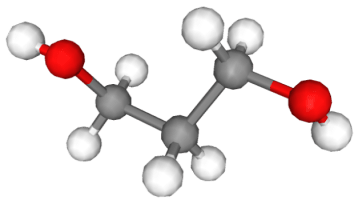
1,3-propanediol
1,3-propanediol

Polyurethane Elastomers with Very Low Glass Transition Temperature

Title: Low temperature segmented copolymer compositions and methods

 Number/Link: US8334356

Applicant/Assignee: Boeing

Publication date: 18-12-2012

Gist”: Polyurethane/polyurea elastomer based on a softblock mixture comprising dihydroxyalkyl terminated polydimethylsiloxane and a hydroxy terminated perfluoroether (or other low Tg softblock like OH terminated polybutadiene, polyphosphazenes etc) together with a rigid diamine chain extender (DETDA type) and a diisocyanate (HMDI in the examples). The softblocks have a molecular weight of 5000 or more and a functionality of 2.

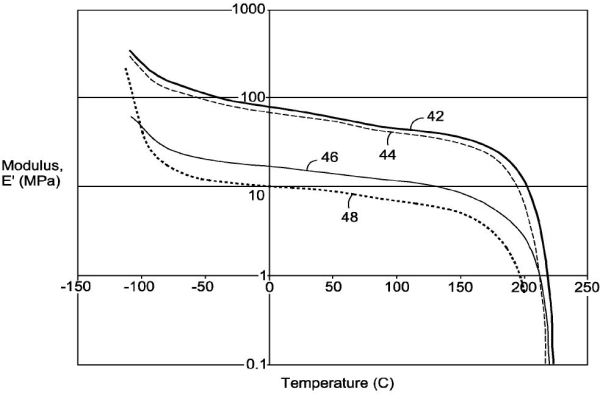
Why it is interesting:  The materials are claimed to have a Tg between -60 and -110°C with still very high elongation and tensile strength values at -100°C. The molecules are linear but will probably not melt because of the high urea content.  They will however be soluble in the correct solvents.

Tgs

Modulus-Temperature graphs of materials according to the invention.

Polyurethane Memory Foam with Improved Thermal Comfort

Title: COMPOSITE MEMORY FOAM AND USES THEREOF

 Number/Link: US2012316254

Applicant/Assignee: ZEDBED INTERNAT INC

Publication date: 13-12-2012

Gist”: Polyurethane memory foam containing polyurethane elastomer particles for improved thermal comfort.

Why it is interesting:  Soy-oil polyols are used to produce both the foam matrix (about 15%) and the PU elastomer (up to 90%).  The particles are about 1mm in size and used in different amounts according to foam density/stiffeness: 2.5% for “pillow grade” and 15% for “mattress grade”. The particles are claimed to improve heat conductivity and therefore comfort.

mattress

  • Pages

  • Categories

  • Enter your email address to follow this blog and receive notifications of new posts by email.

    Join 259 other subscribers
  • Follow Innovation in PU on Twitter