Isotactic Polyether Polyols

Title: POLYETHERS, METHODS OF MAKING SAME, AND USES THEREOF

 Number/Link: WO2012166889

Applicant/Assignee: Cornell University

Publication date: 6-12-2012

Gist”: Isoctactic polypropyleneoxide monols or diols produced by reacting a racemic mixture of propylene oxide  together with a monol or diol ‘starter’ (chain transfer agent) and a specific bimetallic-complex catalyst and an ionic co-catalyst.

Why it is interesting: Isotactic polyols would probably be highly crystalline and polyurethanes produced with them  would therefore show radically different properties compared to conventional a-tactic polyols. Could be very useful in certain types of TPU, coatings, adhesives and maybe rigid foams (gas permeability).
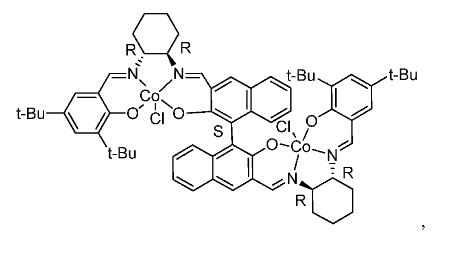
catalyst ex

Example of catalyst used in the invention.

Superabsorbent Polymer Particles Coated with Polyurethane

Title: FAST WATER-ABSORBING MATERIAL HAVING A COATING OF ELASTIC FILM-FORMING POLYURETHANE WITH HIGH WICKING

 Numbers/Links: WO2012/164017 & WO2012/164018 (BASF), WO2012/166787 & WO2012/166831 (P&G)

Applicant/Assignee: BASF and Procter & Gamble

Publication date:  all on 6-12-2012

Gist”: An aqueous composition containing polyurethane and fumed silica is applied to superabsobent polymer (“SAP”) particles followed by heat treatment.

Why it is interesting: The coated superabsorbent particles show improved wicking and swelling behaviour, also under pressure, allowing for the production of thinner diapers. Apparently BASF and P&G cooperated on this invention but filed their own patents: BASF claims the process for the production of the particles, P&G claims the actual articles and “absorbent structures” containing them.

Polyurethane Composites containing Isosorbide

Title: FIBRE COMPOSITE COMPONENT AND A PROCESS FOR THE PRODUCTION THEREOF

 Number/Link: WO2012163845

Applicant/Assignee: Bayer

Publication date: 6-12-2012

Gist”: PU RTM  composite using isosorbide as chain extender to improve viscosity.

Why it is interesting: Isosorbide is a rigid, “non-stacking” chain extender with two non-equivalent hydroxyl groups (one is ‘endo’, the other ‘exo’). Together with isocyanate and some polyol this results in a resin with a slow viscosity build-up, which is useful in e.g. RTM-type composites.

isosorbide

D-Isosorbide (dianhydrosorbitol)

  • Pages

  • Categories

  • Enter your email address to follow this blog and receive notifications of new posts by email.

    Join 259 other subscribers
  • Follow Innovation in PU on Twitter