PIR-Oxazolidone Foams from Natural Oils

Patent Title: METHOD FOR MANUFACTURING A POLYURETHANE-MODIFIED FOAM, FOAM OBTAINED, AND USES

Number/Link: US2018/0030196

Applicant/Assignee:  Soprema et al.

Publication date: 1 February 2018

Gist”: Unsaturated natural oils are epoxidized and reacted with an excess of isocyanate in the presence of a blowing agent.

Why it is interesting: Conventionally natural oils are incorporated into polyurethanes by first converting them to polyols (“NOPs”) by hydroformylation or epoxidation and ring opening and then reacting the NOPs with isocyanates. According to this invention the natural oils (preferably extracted from microalgae) are epoxidized and then mixed and heated with a (e.g. 3:1) excess of isocyanate (e.g. polymeric MDI) in the presence of a blowing agent (e.g. isopentane). It is said that oxazolidone rings from the isocyanate-epoxy reaction will form at the same time as isocyanurate rings and homopolymerized epoxides. The foams are said to be useful for thermal insulation applications.

oxazolidone

Formation of oxazolidone rings according to the invention

Isocyanate-Free Polyaminal-Polyurethane Foams

Patent Title: SYSTEM FOR DIMENSIONALLY STABLE ISOCYANATE-FREE POLYURETHANE FOAM

 Number/Link: WO2018/005142

Applicant/Assignee:  Dow

Publication date: 4 January 2018

Gist”: Polyaldehydes are reacted with polycarbamates in the presence of an acid catalyst, a metal oxide powder and a blowing agent.

Why it is interesting: According to this invention hydrolytically-stable foams can be prepared from a low molecular weight difunctional aldehyde and a polycarbamate with a functionality of about 3.5 to 4 and an equivalent weight of about 200 to 300, in the presence of a blowing agent and a protic acid as catalyst. Surprisingly the foams are rendered hydrolytically stable by the incorporation of a metal oxide powder with a specific particle size. In the examples polycarbamates are prepared by capping high functionality polyols with methylcarbamate and are then reacted with 1,4-cyclohexanedicarbaldehyde together with p-toluensulfonic acid as catalyst, HFC245fa as blowing agent and MgO powder. The foams show densities of 130-170 kg/m³ and are said to be useful as sealants.

CHDA

Cyclohexanedicarbaldehyde

Preventing Ostwald Ripening in Rigid PU Foams

Title: PRODUCTION OF FINE CELL FOAMS USING A CELL AGING INHIBITOR

Number/Link: WO2017093058  (German)

Applicant/Assignee: Evonik

Publication Date: 8 June 2017

“Gist”: Perfluorinated hydrocabons reduce Ostwald ripening in PU foam formulations

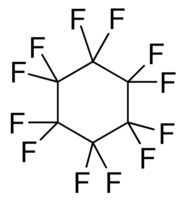
Why it is interesting: Polymeric foams form by nucleation and growth of gass bubbles in the reacting mixture followed by (or simultaneous with) ageing of the bubbles through coalesence and Ostwald ripening, i.e. the growth of larger bubbles at the expense of smaller bubbles. Ostwald ripening ultimately results in fewer and larger cells, which has a negative effect on the thermal insulation properties of rigid foams. According to this invention the ripening effect can be prevented or reduced by incorporating in the foam formulation an “Ostwald hydrophobe”, i.e. a highly hydrophobic liquid which is largely immiscible with the reacting mixture. Examples of such liquids are perfluorinated hydrocabons with a boiling point of less than 150°C, e.g. perfluoropentane, perfluorocyclohexane and perfluoroisohexene (used in the examples).

Perfluorocyclohexane


  • Pages

  • Categories

  • Enter your email address to follow this blog and receive notifications of new posts by email.

    Join 259 other subscribers
  • Follow Innovation in PU on Twitter