Polyurethane Foams from Sugar

Title: Sugar-Based Polyurethanes, Methods for Their Preparation, and Methods of Use Thereof

 Number/Link: US2013030067

Applicant/Assignee: Imperial Sugar Co.

Publication date: 31-01-2013

Gist”: Very low density semi-rigid foams are produced from sucrose syrup and MDI.

Why it is interesting: Open celled foams are prepared from sucrose, water, MDI and preferably a  flame retardant at an NCO index from 20-60 (preferred). A number of examples is given of foams with densities 0f 8 kg/m3 (0.5 pcf) which is quite low.  Mechanical an heat insulation properties are probably not very good but the foams are very ‘green’ and cheap. Useful as sprayable acoustic foams?

Sucrose
Sucrose

Insulating Polyurethane Foams Containing Impregnated Aerogel Particles

Title: METHOD FOR MAKING ORGANIC FOAM COMPOSITES CONTAINING AEROGEL PARTICLES

 Number/Link: WO2013000861

Applicant/Assignee: Dow

Publication date: 3-01-2013

Gist”: Polyurethane or polyisocyanurate (or -less preferred- extruded foams like EPS foams) are produced in the presence of aerogel particles impregnated with blowing agents resulting in composite foams with exceptional insulation properties.

Why it is interesting: The blowing agent evaporates during the reaction (or extrusion),expands the foam and prevents the aerogel particles of losing their porosity and low density.  Already 0.1% w/w of the particles is claimed to have a significant impact on insulation properties.  In the examples an HFC blowing agent is used together with aerogel particles with an average size of about 1mm.
It appears that composites of aerogels together with PU or PIR, but also with PS and rockwool e.g. are becoming an ever more important trend in insulation.

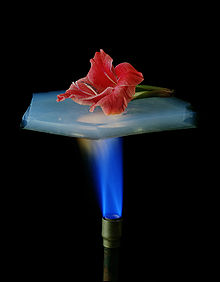
Aerogel (Wikipedia)

Aerogel (Wikipedia)

Polymeric Foams from Natural Oils (No Polyurethane)

Title: BIO-BASED FOAM FROM NATURAL OILS

 Number/Link: US2012295993

Applicant/Assignee: Not yet disclosed but probably Univ. Delaware

Publication date: 22-11-2012

Gist”: Natural oils are functionalized with different (mutually reactive) functional groups, blown/frothed with CO2 and  subsequently cured optionally in the presence of chain extenders.

Why it is interesting: The foams of this invention are made from 100% renewable materials and without “toxic” isocyanates.  Densities in the examples range from about 15 to 200 kg/m³.  While the properties, look and feel of these materials probably do not come close to those of  PU foams, they could be interesting competitors in some fields such as packaging foams.

  • Pages

  • Categories

  • Enter your email address to follow this blog and receive notifications of new posts by email.

    Join 259 other subscribers
  • Follow Innovation in PU on Twitter