Polyurethane Tissue Adhesives

Patent Title: URETHANE DECOMPOSING METHOD AND URETHANE DECOMPOSING AGENT

 Number/Link:  US2016/0257800

Applicant/Assignee: Obihiro University

Publication date: 8-09-2016 (priority PCT/JP)

Gist”: Prepolymer from ether-ester polyol and aliphatic isocyanate

Why it is interesting: There is a growing trend in current surgerical practice to replace sutures and staples with adhesives. These tissue adhesives need to have a particular set of properties, like the correct viscosity, hardening speed, biodegradability and toxic and allergenic properties. Current surgical adhesives are often cyanoacrylates, which react very fast, are brittle and show poor biodegradability, or protein-based adhesives which are costly and form weak bonds. According to this invention an improved polyurethane tissue adhesive can be prepared from an isocyanate-ended prepolymer based on an aliphatic isocyanate and a polyol.  The polyol is prepared from a starter polyol or amine which is reacted with a mixture of an alkoxide and about 10-20% of a  lactide (or glycolide or cyclic acid anhydride).  The lactide is randomly copolymerized with the alkoxide using DMC catalysis. The polyol is then reacted with an aliphatic isocyanate, pref. HDI or IPDI in a NCO/OH ratio of about 8:1. After that monomeric isocyanate is removed by thin film distillation down to less than 1% free monomer.
The adhesives are said to be fast, non-toxic, non-allergenic and biodegradable.

L-Lactide

L-Lactide

Dispersions of Comb-Structured Polyurethanes

Patent Title: POLYURETHANE-BASED BINDER DISPERSION

 Number/Link: WO2016122569

Applicant/Assignee: Hewlett-Packard

Publication date: 4-08-2016

Gist”:  Aqueous dispersions of “1,2”-dihydroxypolyacrylate -based polyurethanes

Why it is interesting: According to this invention aqueous dispersions can be made of “comb -structured” polyurethanes which are based on polyols having two hydroxyl groups at one end of the chain.  The “1,2”-diols are made by copolymerizing (e.g.) methylmethacrylate and n-butylmethacrylate together with thioglycerol up to a Mw of about 2000. The polyols can then be reacted with isocyanate and dimethylolpropionic acid for dispersion in water. The dispersions are said to have a small average particle size (10-100 nm) and be especially useful as binders for inkjet-ink.

Thioglycerol

Thioglycerol

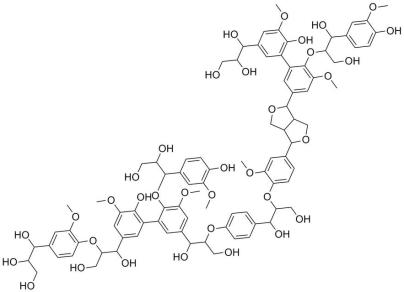
PET-Lignin Polyols

Patent Title: HIGH RECYCLE CONTENT POLYOLS FROM THERMOPLASTIC POLYESTERS AND LIGNIN OR TANNIN

 Number/Link: WO2016/118411

Applicant/Assignee: Resinate Materials Group

Publication date: 28-07-2016

Gist”: PET is glycolized and then reacted with lignin or tannin

Why it is interesting: This application is about ‘sustainable’ aromatic polyester polyols partly based on recycled materials and partly on biorenewable materials. According to the invention the polyols can be prepared by first glycolizing (waste) PET and subsequently reacting the mixture with lignin at 110-210°C while removing volatile condensation products.  The resulting polyols (pref) show a OH value between 40 and 400 mg KOH/g, a fn of 2-2.2 and a viscosity at 25°C of 500 to 3000 cP. In the examples polyols with up to 25 wt% lignin are shown. The polyols are said to be useful e.g. in 2K PU coating compositions.

Part of a lignin structure

Part of a lignin structure

  • Pages

  • Categories

  • Enter your email address to follow this blog and receive notifications of new posts by email.

    Join 259 other subscribers
  • Follow Innovation in PU on Twitter