Flexible Polyurethane Foams with Improved ‘Feel’

Title: EXPANDABLE POLYURETHANE COMPOSITION AND MANUFACTURING METHOD OF FLEXIBLE POLYURETHANE FOAM

 Number/Link: US2015/0045466

Applicant/Assignee: Momentive

Publication date: 12-02-2015 (priority PCT-JP)

Gist”: Use of ester plasticizers in flexible foams

Why it is interesting: According to this invention both the humid aged compression set and the hand ‘feel’ of flexible foams can be improved by incorporating a few percent of a mono- di- tri- or tetra- ester plasticizer in the polyol. In the examples 1 to 4 php of isopropyl myristate does indeed seem to improve the humid aged compression set of an MDI-TDI foam, however not all examples are very convincing.

Isopropyl Myristate

Isopropyl myristate

Classic PU Patent of the Month: ICI on MDI Prepolymers and “Cold Cure” Flexible Foams (1978)

Title: Liquid polyisocyanate compositions

 Number/Link:  EP10850

Applicant/Assignee: Imperial Chemical Industries

Publication date: 14-05-1980

Gist”: Liquid compositions from 2,4’/4,4′-MDI  prepolymers and polymeric MDI.

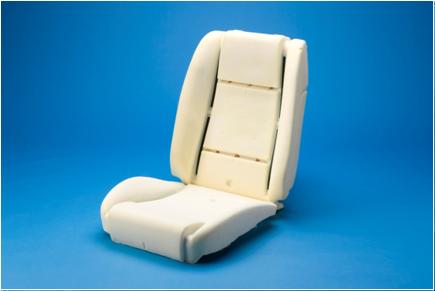
Why it is interesting: The first polyurethane flexible foams were all based on toluene diisocyanate (TDI).  Other commericially available isocyanates like “pure MDI”  (4,4’/ 2,4′- diphenylmethane diisocyanates mixtures) and “crude MDI” (mixtures of MDI and its higher homologues) were not suited for flexible foam production: the former because of it’s high crystallinity and therefore too high melting point and the latter because of its too high functionality.  This classic invention solved the problem by prepolymerizing  a 2,4’/4,4′-MDI mixture with a “flexible” polyol to an NCO content of 8 to 26% and then adding 10-50% of crude MDI to obtain a liquid composition. These liquid MDI compositions allowed the production of cold cure moulded flexible foams and the first MDI-based car seat cushions.

Cold cure moulded car seat cushions

Cold cure moulded car seat cushions

Flexible Foams from Inverse NOP Prepolymers

Title: Polyurethane Foam

 Number/Link:US2014329923

Applicant/Assignee: Green Urethanes

Publication date: 06-11-2014 (priority PCT)

Gist”: Flexible polyurethane foams based on OH-ended natural-oil polyol prepolymers

Why it is interesting: Polyols based on natural oils (NOPs) such as rapeseed-, soy-, castor oil and the like are hydrophobic, have sterically hindered hydroxyl groups and are therefore not compatible with conventionally used polyols and isocyanates.   The amount of natural oil-based polyols that can be used is therefore limited to less than about 30% for conventional flexible slabstock and even less (5-10%) for HR foams. According to the current invention, prepolymerizing the NOP with a multifunctional isocyanate to form an OH-ended (‘inverse’) prepolymer, improves compatibility and reactivity and even reduces or eliminates the typical smell associated with these compounds. In the examples about 10% of the OH groups of different types of NOPs are pre-reacted with polymeric MDI using a gelling catalyst.  The prepolymers are then foamed using TDI, water and conventional polyols. Flexible foams are produced containing 50-75% NOP on the total amount of polyol used.

Castor Oil

Typical castor oil component

  • Pages

  • Categories

  • Enter your email address to follow this blog and receive notifications of new posts by email.

    Join 259 other subscribers
  • Follow Innovation in PU on Twitter