Solid Polyurethane Electrolyte

Title: POLYURETHANE BASED MEMBRANES AND/OR SEPARATORS FOR ELECTROCHEMICAL CELLS

 Number/Link: WO2013/062990

Applicant/Assignee: Lubrizol

Publication date: 2/05/2013

Gist”:  TPU prepared from a DEG-adipate polyester diol, HQEE and 4,4′-MDI can be used as Li ion-conducting electrolytes  in electrochemical cells.

Why it is interesting: Because of the rapidly increasing use of phones, tablets, electric cars etc. research into improved batteries is a very hot topic. Many modern batteries use Li+-conducting seperators or ‘membranes’ with specific conductivity, solvent swelling and heat-resistance properties.  According to this invention  improved separator membranes can be produced from (a surprisingly simple) thermoplastic polyurethane based on (preferably) 4,4′-MDI, hydroquinone bis (hydroxyethyl)ether as chain extender and a DEG-adipic polyester diol with a MW of 2000 to 3000.  Lithium conductivity can (optionally) be further improved by incorporating Li+-conducting solids like Li-Borates, Li- silicates, Li salts or complexes and the like.
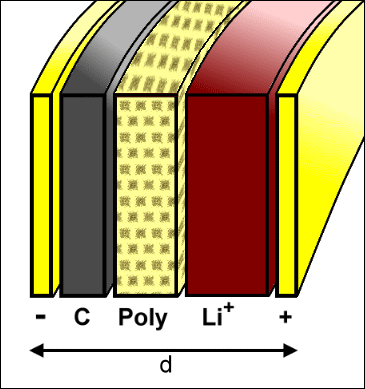
Schematic Li-polymer battery.

Schematic Li-polymer battery.

Aqueous Polyurethane Dispersion with Integrated Nanoparticles

Title: AQUEOUS DISPERSIONS OF POLYURETHANE AND NANOPARTICLES

 Number/Link: WO2013/059106

Applicant/Assignee: Bayer

Publication date: 25-04-2013

Gist”: Amino-functional inorganic nanoparticles are reacted with residual isocyanate groups of a PUD-forming polyurethane prepolymer and subsequently dispersed in water.

Why it is interesting: A water-dispersible polyurethane prepolymer is made from isocyanate, polyol and chain extender in which polyol and/or chain extender comprise ionic or potentially ionic groups.  The prepolymer is produced with a surplus of isocyanate which is subsequently reacted with amino-functional inorganic nanoparticles.  The nanoparticles consist of e.g. metal oxides which were reacted with a “bridging compound” comprising an isocyanate-reactive group (NH2 or OH) and a particle-reactive group e.g. a halogen or silane group. The polyurethane with covalently integrated nanoparticles can then be dispersed in water using a known process.  The resulting PUD has a high shelf-life and can be used in coatings, adhesives, films etc. with improved properties.

Polyurethane dispersion and film made from it. (Wikimedia)

Polyurethane dispersion and film made from it. (Wikimedia)

Polyurethane Elastomer with Greatly Improved Abrasion Resistance

Title: POLYURETHANE WITH IMPROVED ABRASION RESISTANCE, THE METHOD FOR PREPARING THE SAME AND USE THEREOF

 Number/Link: US2013059935

Applicant/Assignee: Bayer

Publication date: 7-03-2013

Gist”: Use of polybutadiene, high in 2,3-trans butene, to improve abrasion resistance of PU elastomers

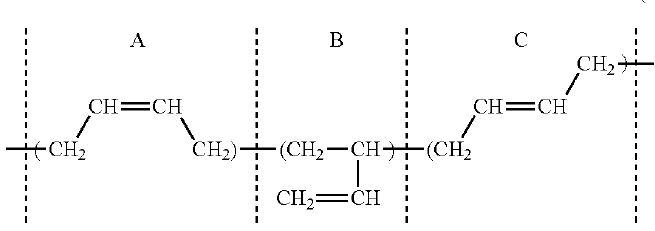
Why it is interesting: A polybutadiene (not the diol!) with a molecular weight of about 10,000 and containing 10-20% 1,2-cis butene and about 50% of 2,3-trans butene is used in an amount of up to 5% on the total formulation, resulting in a much improved abrasion resistance. It is not clear why the 2,3 trans level has to be so high – it may have to do with crystallinity and/or compatibility with the PU matrix – but no comparative examples are given. While the idea is interesting, it is not new and only a slight variation on a Dow patent of 1996: US5510054.

2,3 trans-, 1,2- and 2,3-cis butene units

2,3 cis-, 1,2- and 2,3-trans butene units

  • Pages

  • Categories

  • Enter your email address to follow this blog and receive notifications of new posts by email.

    Join 259 other subscribers
  • Follow Innovation in PU on Twitter