Dispersions of Comb-Structured Polyurethanes

Patent Title: POLYURETHANE-BASED BINDER DISPERSION

 Number/Link: WO2016122569

Applicant/Assignee: Hewlett-Packard

Publication date: 4-08-2016

Gist”:  Aqueous dispersions of “1,2”-dihydroxypolyacrylate -based polyurethanes

Why it is interesting: According to this invention aqueous dispersions can be made of “comb -structured” polyurethanes which are based on polyols having two hydroxyl groups at one end of the chain.  The “1,2”-diols are made by copolymerizing (e.g.) methylmethacrylate and n-butylmethacrylate together with thioglycerol up to a Mw of about 2000. The polyols can then be reacted with isocyanate and dimethylolpropionic acid for dispersion in water. The dispersions are said to have a small average particle size (10-100 nm) and be especially useful as binders for inkjet-ink.

Thioglycerol
Thioglycerol

Novel Cellopener for Flexible- and Viscoelastic PU Foams

Patent Title: POLYURETHANE FOAM WITH AQUEOUS POLYMER DISPERSION  & VISCOELASTIC POLYURETHANE FOAM WITH AQUEOUS POLYMER DISPERSION

 Number/Link: WO2016/100306 & WO2016/100263

Applicant/Assignee: Dow

Publication date: 23-06-2016

Gist”: Dispersions of acid modified olefins in water act as cellopeners

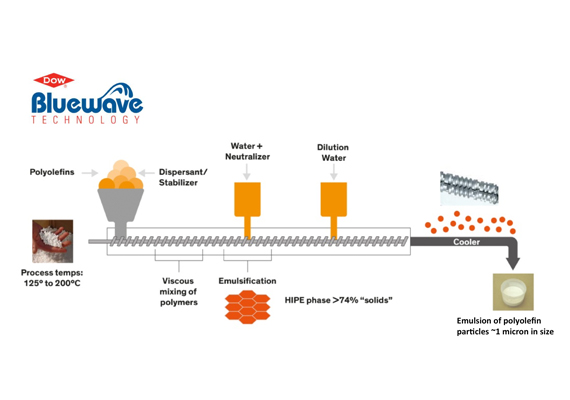
Why it is interesting: According to this invention aqueous dispersions of acid-modified olefins can be used as cellopeners for conventional, high resilience and viscoelastic foams. The examples show that a 40% ‘solids’ dispersion of an acrylic acid – ethylene copolymer in water, used in about 1 to 2% on the total isocyanate-reactive composition has a clearly positive effect on foam air-flow properties. The polymer dispersions can be made according to Dow’s proprietary BLUEWAVE™ extrusion technology.

The BLUEWAVE dispersion process

The BLUEWAVE dispersion process


Self-Crosslinkable Polyurethane

Patent Title: Self-Crosslinkable Polymer and Aqueous Dispersion Comprising Particles of the Same

 Number/Link: US2016/0159959

Applicant/Assignee: Valspar Sourcing

Publication date: 9-06-2016

Gist”: Aqueous dispersion of polyurethane having both azide and carbonyl groups in the backbone

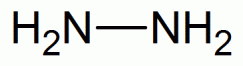
Why it is interesting: Properties of water-based PU coatings can often be improved by incorporating olefinically unsaturated groups in the polymer which can be crosslinked using radiation. According to this invention a self-crosslinking (i.e. without the need for radiation) aqueous PU coating composition can be made by incorporating both azide- and carbonyl groups into the PU backbone. When the water evaporates and the film forms these groups will react forming a hydrazone-type bond. The self-crosslinkabe polymer can be prepared by first making an NCO-ended prepolymer containing a reactive double bond, by (e.g.) reacting some of the NCO groups with hydroxyethylmethacrylate (HEMA). This prepolymer is then dispersed in water together with hydrazine and and acrylate like MMA or BA. The hydrazine will react with the NCO groups, introducing azide groups into the backbone.  The acrylate and the prepolymer are then suspension polymerized using an initiator.  The PU backbone can (optionally) contain a water dispersible group – e.g. by incorporating dimethylolpropanoic acid. The self-crosslinkable polymer is said to be especially useful for use in wood coating compositions.

Hydrazine

Hydrazine


  • Pages

  • Categories

  • Enter your email address to follow this blog and receive notifications of new posts by email.

    Join 259 other subscribers
  • Follow Innovation in PU on Twitter