Polyurethane-Epoxy IPN Composites

Patent Title: POLYMER COMPOSITE THERMAL INTERFACE MATERIAL WITH HIGH THERMAL CONDUCTIVITY

 Number/Link: WO2016/079627

Applicant/Assignee: IBM

Publication date: 26-05-2016

Gist”: PU-Epoxy IPN particle composites show improved thermal conductivity

Why it is interesting: The application is about thermally conductive adhesives for use with electronic components. Commonly these materials consist of polymers filled with thermally- (but not electrically-) conductive particles such as AlN, BN and ZnO. According to the invention the thermal conductivity of these composites can be improved by using a polyurethane-epoxy true interpenetrating polymer network (IPN) as the matrix. In the examples a MDI-polycaprolactone prepolymer is mixed with a BPA diglycidylether prepolymer and boron nitride (BN) particles and crosslinked using trimethylolpropane and imidazole.  The thermal conductivity of the composite shows a synergy, meaning that it is clearly higher than the conductivities of both the PU or EP composites. The synergy is said to be due to an enhanced distribution of the BN particles and (because this is IBM and they are very clever) due to enhanced phonon scattering.
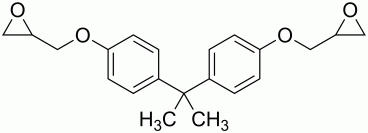
Bisphenol-A diglycidylether

Bisphenol-A diglycidylether

Hybrid Polyurethane-Peptide Dispersion

Patent Title: AQUEOUS PEPTIDE-STABILIZED POLYURETHANE DISPERSIONS

 Number/Link: W02016058909

Applicant/Assignee: Henkel; Max Planck Ges.

Publication date: 21-04-2016

Gist”: An NCO-ended prepolymer is reacted with a peptide mixture in water at correct pH

Why it is interesting: According to this invention a low-VOC, surfactant- free, stable dispersion can be prepared by reacting an isocyanate-ended preopolymer with an aqueous solution of peptides. The prepolymer is prepared from a polyether-, polyester- or PDMS diol and a surplus of (preferably) aliphatic isocyanate. The peptide mixture is obtained by hydrolysis or enzymatic cleaving of naturally occuring proteins and is dispersed in water at a pH well above the highest isoelectric point present in the mixture. This will ensure reaction of the isocyanate with the peptides instead of water.
Polymer-protein hybrids are interesting because they allow for unique properties not attainable with synthetic polymers alone, such as a selective and specific interaction with other biomolecules and a controlled response to external stimuli like pH and temperature.

Example of a tetrapeptide: Val-Gly-Ser-Ala. (Wikipedia)

Example of a tetrapeptide: Val-Gly-Ser-Ala. (Wikipedia)


Vinyl-Functional UV-Curable Polyurethanes

Patent Title: ALKENYL ETHER POLYOLS

 Number/Link: WO2016038112 (German)

Applicant/Assignee: Henkel

Publication date: 17-03-2016

Gist”: Alkenylether-functional polyols are used in oligomeric PU adhesives.

Why it is interesting: Alkenylether-functional groups are highly reactive and can be cured by UV-initiated cationic polymerization. This has the advantage of being unsensitive to oxigen which allows for so-called “dark cure”, i.e. the continuing polymerization after a first pulse of UV light. According to this invention, vinyl functional polyols are prepared by polymerizing a hydroxyl- or amine functional vinyl ether, e.g. 4-hydroxybutylvinylether (HBVE) or 3-aminopropylvinylether with epoxides or cyclocarbonates. The polyols can then be reacted with isocyanates resulting in UV curable polyurethanes.  In an example HBVE is reacted with 1,4-butanedioldiglycidylether to make the vinyl-functional polyol which is then further reacted with isophorondiisocyanate to make the PU adhesive.

1,4-butandioldiglycidylether

1,4-butandioldiglycidylether

  • Pages

  • Categories

  • Enter your email address to follow this blog and receive notifications of new posts by email.

    Join 259 other subscribers
  • Follow Innovation in PU on Twitter