Polymer Polyols with Phosphorous-Containing Particles

Title: PHOSPHOROUS BASED POLYADDITION/POLYURETHANE-UREA POLYOLS

 Patent Number & Link: WO2013101524

Applicant/Assignee: Dow

Publication date: 4-07-2013

Gist”: PHD and PIPA polyols are produced in the presence of phosphorous containing polyols

Why it is interesting: PDH or PIPA polymer polyols can be prepared by dissolving a low MW amine- or  hydroxyl containing co-reactant in a ‘base polyol’ and subsequently reacting with an isocyanate. When executed properly and with the correct ingredients this results in a stable dispersion of respectively urea or urethane particles in the base polyol. (see also previous posts in this blog). This invention states that by using phosphorous flame retardants containing amine or hydroxyl groups in addition to the co-reactant, PIPA or PHD (or hybrid) polymer polyols can be prepared with flame the retardant incorporated in the particles, resulting in a flame retardant polymer polyol.
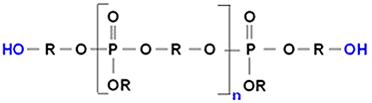
Phosphorous polyol as used in the invention

Phosphorous polyol as used in the invention

Yet Another Way to Make Isocyanate Prepolymers with Low Free Monomeric Isocyanate

Title: LOW-VISCOSITY REACTIVE POLYURETHANE COMPOUNDS

 Number/Link: WO2013092564 (in German)

Applicant/Assignee: Bayer

Publication date: 27-06-2013

Gist”: A prepolymer with very low free diisocyanate content and relatively low viscosity can be prepared by reacting MDI having a high 2,4′ isomer content with a low MW diol in a first step and adding a high MW polyol in a second step.

Why it is interesting: The use of asymmetric diisocyanates (having isocyanate groups with different reactivities) to prepare prepolymers with low free monomers is well known.  Prepolymers prepared using diisocyanates with high levels of 2,4′-MDI, 2,4-TDI, IPDI etc. will however still show a very high viscosity at low isocyanate content. Bayer has now found that prepolymers with lower free monomer and lower viscosity can be prepared by using two polyols reacted in seperate stages. In a first step an MDI with >95% 2,4′ isomer is reacted with a (pref) diol with a molecular weight between 60 and 700 to produce a prepolymer with an NCO content of more than 15%. In a second step this prepolymer is then further reacted with a ‘conventional’polyol to obtain the final prepolymer.  In an example a prepolymer with less than 0.1% free MDI and a viscosity of 25 Pa.s at 40°C was prepared.

2,4'-MDI

2,4′-MDI

A New Way to Remove Monomeric Isocyanate from Prepolymers

Title: REDUCTION OF THE FRACTION OF MONOMERS COMPRISING ISOCYANATE GROUPS IN MOISTURE-CURING POLYURETHANE COMPOSITIONS

 Number/Link: US2013/0158210

Applicant/Assignee: Sika

Publication date: 20-06-2013 (priority PCT/EP)

Gist”: Reduction of monomeric MDI in moisture curable prepolymers by addition of amino functional silica particles.

Why it is interesting: As noted in some previous posts in this blog (*) reduction of monomeric isocyanate from moisture curable systems is an important trend in PU systems development. The current invention solves this problem by adding isocyanate-reactive SiO2 particles to the prepolymer composition.  The particles have a preferred average size of 50-60μm, are (nano-)porous with a large specific surface area and have been chemically modified with (preferably) aminosilanes to make them amino-functional. Particles of this type with different functional groups are commercially available under the QUADRASIL tradename.
(*) Note that you can use the ‘search’ or ‘category’ boxes on the right (or in case of a mobile device on the bottom) of this page to help you navigate the site.

Porous Silica Particles

Porous Silica Particles

  • Pages

  • Categories

  • Enter your email address to follow this blog and receive notifications of new posts by email.

    Join 259 other subscribers