Polyurethane Elastomers with High Abrasion Resistance

Title: POLYURETHANE WITH IMPROVED ABRASION RESISTANCE, THE METHOD FOR PREPARING THE SAME AND USE THEREOF

 Number/Link: US2013/0274365

Applicant/Assignee: Bayer

Publication date: 17-10-2013 (priority PCT/DE)

Gist”: Small amounts of polyisoprene improve abrasion resistance of elastomers

Why it is interesting: It is known that polyether polyols have advantages over polyester polyols for the production of polyurethane elastomers: the resulting elastomers have better low temperature properties, better hydroslysis resistance and antimicrobial properties, however the mechanical properties as well as the abrasion resistance are lower. According to this invention the abrasion resistance of polyether elastomers can be greatly improved by incorporating a small amount of polyisoprene in the formulation. In the examples 2% polyisoprene with a MW of 28,000 or 45,000 is used in a formulation of polyether polyol, butanediol, water and catalyst together with a non-disclosed isocyanate. The resulting elastomers have a density of 600 kg/m3 and show a markedly improved abrasion resistance.
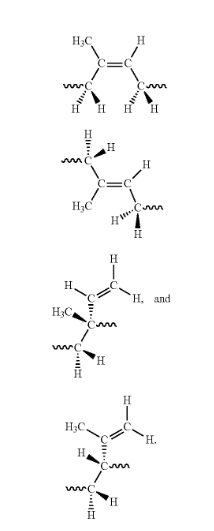
Structural units present in polyisoprene

Structural units present in polyisoprene

POLYURETHANE WITH IMPROVED ABRASION RESISTANCE, THE METHOD FOR PREPARING THE SAME AND USE THEREOF

Polyurethane/Polyurea Elastomers from 2,4′-MDI and MDA

Title: MOLDED POLYURETHANE ELASTOMER PARTS MADE OF DIPHENYLMETHANE DIISOCYANATE-BASED NCO PREPOLYMERS AND METAL SALT COMPLEXES, AND A METHOD FOR PRODUCING SAME

 Number/Link: US2013267655

Applicant/Assignee: Bayer

Publication date: 10-10-2013 (priority PCT/DE)

Gist”: Molded PU/PUA elastomers are prepared from a 2,4′-MDI based prepolymer cured with blocked MDA

Why it is interesting: A prepolymer with an NCO content between 3 to 7% is prepared from MDI containing more than 97% of the  2,4′ isomer together with a diol with an OH value of about 100.  (e.g a PTMEG or a polycaprolacton).  The prepolymer is then cured with a salt-complexed diphenylmethanediamine (“blocked MDA”). Because of it’s relatively low viscosity and long potlife the system allows for the production of thick-walled, bubble-free molded elastomers.  Probably because there is less premature polyurea phase separation (due the 2,4′-MDI) the system cures homogeneously.

4,4'-MDA

4,4′-MDA

Flexible Foams with Improved Humid-Aged Properties

Title: POLYURETHANE FOAM PRODUCTION PROCESS, PRE-MIX, FORMULATION, AND PRODUCT

 Number/Link: WO2013/143129

Applicant/Assignee: Air Products

Publication date: 3-10-2013

Gist”: Use of halohydrins as an additive in flexible foam formulations improves humid aged properties.

Why it is interesting: Properties of flexible polyurethane foams after humid-ageing appear to greatly improve when about 0.5 to 1 pphp of a halohydrin is added to the formulation.  “Halohydrin” is in this case used as a synonym for halo-alcohol. Mentioned are 2-(2-chloroethoxy)ethanol, 2,2-dichloroethanol and 1-chhloro-6-hexanol e.g. According to the examples the effect appears to be real and most pronounced for mechanical properties after humid ageing viz. tensile and elongation properties. It is not immediately clear to me what the underlying mechanism could be.

Chloroethoxyethanol

Chloroethoxyethanol

  • Pages

  • Categories

  • Enter your email address to follow this blog and receive notifications of new posts by email.

    Join 259 other subscribers