Proppant Coatings with Controlled Release

Patent Title: TIME RELEASED DELIVERY OF FUNCTIONAL CHEMICALS

 Number/Link: US2018/0127638

Applicant/Assignee:  Covestro

Publication date: 10 May 2018

Gist”:  Functional chemicals are reacted with isocyanates for controlled release in fracking wells.

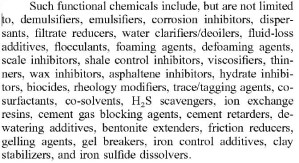
Why it is interesting:  Hydraulic fracturing for oil and gas production is a complex process that requires a “fracking fluid” containing a proppant together with a host of chemicals like defoamers, demulsifiers, biocides etc.  According to this application it is advantageous that these chemicals are released slowly over time during the complete lifecycle of the well. It is stated that this can be achieved by reacting the additives with mono- or polyfunctional isocyanates and (e.g.) incorporating these compounds into the proppant coating.  The additives should have an active hydrogen able to react with isocyanate, or be modified to have such.
The text does not propose a mechanism for this controlled release and it is not clear why this should work.  And -strangely- the “examples” section does not contain any examples.       
list

Some fracking fluid additives.

Catalyst System for Frothed Foams

Patent Title: METHOD FOR DELAYING CURING IN POLYURETHANE AND COMPOSITIONS AND ARTICLES MADE THEREFROM

 Number/Link: WO2018/075302

Applicant/Assignee:  Rogers

Publication date: 26-April-2018

Gist”: A mixture of  a metal acetylacetonate and a catalytic inhibitor prevents premature curing

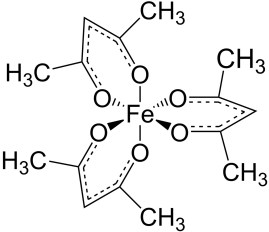
Why it is interesting:  A catalyst system that prevents premature curing of frothed (PORON® – type) foams consists of  ferric acetylacetonate catalyst and a β-diketone inhibitor e.g. acetylacetone or dibenzoyl methane. The catalyst combination allows for handling of the raw materials at 55°C for 5 minutes without reacting.  Frothed foams tend to have improved properties, like compression set as compared to conventional foams.

Tris(acetylacetonato)iron(III)

Tris(acetylacetonato)iron(III)  (Wikipedia)

Hybrid Polyurethane Elastomer

Patent Title:  PROCESS FOR PRODUCING ELASTOMERS

 Number/Link: WO2018069348 (German)

Applicant/Assignee:  Covestro

Publication date: 19 April 2018

Gist”: Unsaturated polycarbonate polyols are reacted with isocyanates together with a peroxide

Why it is interesting: Unsaturated polyethercarbonate polyols are prepared by reacting alkyleneoxides (e.g. PO) together with carbondioxide and an unsaturated monomer like a glycidylether or -ester or cyclooctadienemonoepoxide. These polyols can then be reacted with isocyanates in the presence of  a free-radical initiator like an peroxide. The resulting material can then be crosslinked in a separate step. The hybrid elastomers are said to have improved tensile properties at same or similar hardness.
A related application is WO2018/069350.

glycidylmethacrylate

Glycidylmethacrylate

  • Pages

  • Categories

  • Enter your email address to follow this blog and receive notifications of new posts by email.

    Join 259 other subscribers