Brominated Polyurethane Oligomers

Title: FLAME-RETARDING OLIGOMERIC BROMINATED URETHANE COMPOSITIONS

 Number/Link: US2013/0217286

Applicant/Assignee: Lubrizol

Publication date: 22-08-2013 (priority PCT)

Gist”: Use of highly brominated isocyanate-reactive monomers to prepare brominated PU oligmers useful as non-leaching fire retardants.

Why it is interesting: Brominated fire retardants are highly effective in polyurethanes but their use is being phased-out because of environmental issues and the production of some of them will be discontinued in the near future. Brominated PU oligomers can be used as fire retardants with less environmental problems as they are not fugitive and will leach less.  The oligomers can be produced using monofunctional highly brominated isocyanate-reactive monomers like tribromoneopentanol or pentabromophenol. Difunctional brominated monomers can also be using together with monofunctional isocyanates to control the molecular weight which is preferably between 800 and 20,000 (claimed).  The oligomers can be used as fire retardants in PU dispersions (claimed) and in other polyurethane compositions e.g. in TPUs.

pentabromophenol

pentabromophenol

Over-Indexed and Crosslinkable Thermoplastic Polyurethane

Title: METHOD FOR MAKING OVER-INDEXED THERMOPLASTIC POLYURETHANE ELASTOMER PRECURSOR AND THERMOPLASTIC POLYURETHANE ELASTOMER MADE FROM THE PRECURSOR

 Patent Number & Link: WO2013/103633

Applicant/Assignee: Nike

Publication date: 11-07-2013

Gist”: A TPU is produced at an NCO index of about 110 comprising an unsaturated chain extender .  The material can be injection moulded and subsequently cured with moisture and free radical polymerization.

Why it is interesting: A thermoplastic PU ‘precursor’ is prepared by reactive extrusion of  a polyol (e.g. a 2000MW polytetramethylene ether glycol), an unsaturated chain extender (e.g. trimethylolpropane monoallyl ether – TMPME), optional additives and MDI at an NCO index of 110 to 115 (preferred). After drying, the resulting pellets can be injection- or compression moulded and then cured by moisture and by heat or UV radiation. The resulting PU-polyurea is claimed to have improved toughness, durability and ‘scuff resistance’ compared to conventional TPUs.  The material appears to have been developed for the golf ball industry.  Nike has filed at least two related ‘golf ball patents’: WO2013/103673 and WO2013/103669.

TMPME: unsaturated chain extender used in the invention

TMPME: unsaturated chain extender used in the invention

Solid Polyurethane Electrolyte

Title: POLYURETHANE BASED MEMBRANES AND/OR SEPARATORS FOR ELECTROCHEMICAL CELLS

 Number/Link: WO2013/062990

Applicant/Assignee: Lubrizol

Publication date: 2/05/2013

Gist”:  TPU prepared from a DEG-adipate polyester diol, HQEE and 4,4′-MDI can be used as Li ion-conducting electrolytes  in electrochemical cells.

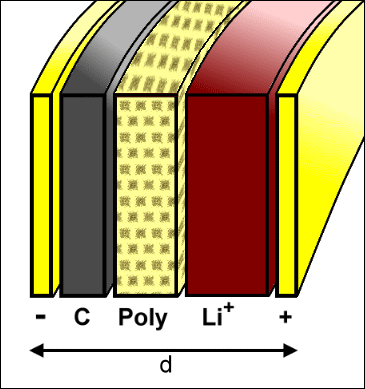
Why it is interesting: Because of the rapidly increasing use of phones, tablets, electric cars etc. research into improved batteries is a very hot topic. Many modern batteries use Li+-conducting seperators or ‘membranes’ with specific conductivity, solvent swelling and heat-resistance properties.  According to this invention  improved separator membranes can be produced from (a surprisingly simple) thermoplastic polyurethane based on (preferably) 4,4′-MDI, hydroquinone bis (hydroxyethyl)ether as chain extender and a DEG-adipic polyester diol with a MW of 2000 to 3000.  Lithium conductivity can (optionally) be further improved by incorporating Li+-conducting solids like Li-Borates, Li- silicates, Li salts or complexes and the like.

Schematic Li-polymer battery.

Schematic Li-polymer battery.

  • Pages

  • Categories

  • Enter your email address to follow this blog and receive notifications of new posts by email.

    Join 259 other subscribers
  • Follow Innovation in PU on Twitter